What to Wear
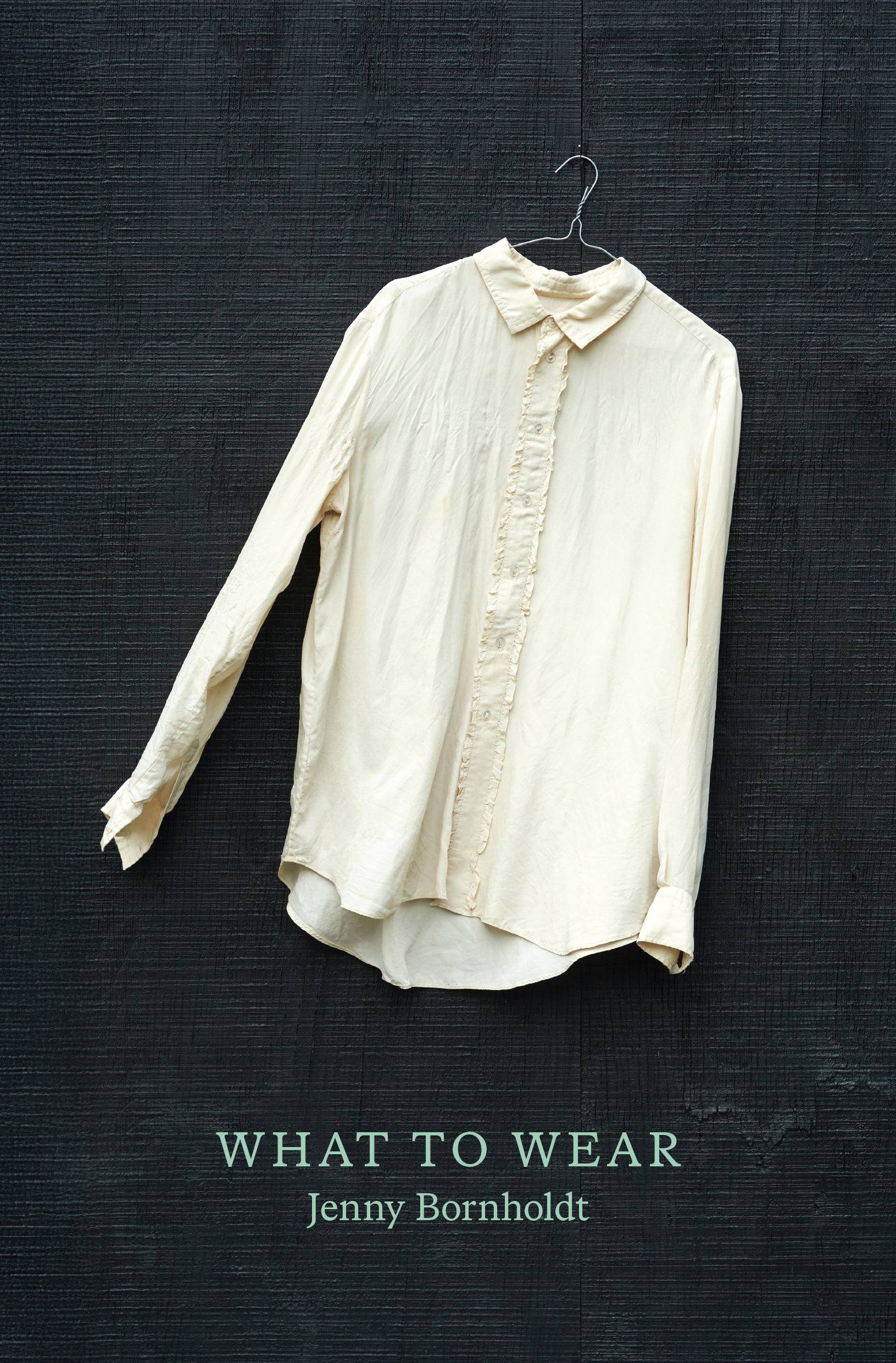
What to Wear by Jenny Bornholdt. THWUP (2026). RRP. $25.00. PB, 72pp. ISBN: 9781776923069. Reviewed by Jordan Hamel.
Jenny Bornholdt’s What to Wear is the former poet laureate’s 12th collection, and, to my deep shame, the first I’ve read cover to cover (a mistake I’ve since rectified). Coming in with mostly fresh eyes to review one of our most revered and celebrated poets feels as superfluous as it is intimidating. It’s like flying to Pisa and telling the Italians their tower isn’t straight.
To steel myself for such a task, I familiarised myself with Bornholdt’s back catalogue as fast as possible and read every review of every collection of hers I could find online—that’s a normal thing to do, right? Looking through any number of previous reviews, regardless of the year of publication or collection in question, you’ll find variations of the same themes and characteristics drawn out and mused upon: wry humour, gentleness, finding the immense in the minuscule, and others that have perhaps become synonymous with that generation and school of New Zealand poet. The most recursive idea that all reviewers seem to highlight or talk about throughout Bornholdt’s career is a poetics of micro attention: a mode of unrivalled observation or a meditative noticing.
Bornholdt has spawned countless imitators over the past couple of decades who produce sparse volumes of middle-class urban pastorals that, despite their attentiveness to still life, often end up feeling overly-cautious, saccharine, and, quite frankly, dull. These traps loom large within this oeuvre, but Bornholdt has always managed to not only dodge them but to play with them on the page in a way that continues to set her apart.
Am I saying no one can do it like Jenny Bornholdt, or that no one should try? No. But having just read a complete year’s worth of Aotearoa poetry as critically as possible while judging the Ockham New Zealand Book Awards, I wonder if many are confusing the acts of minute attention as poetic accomplishments in and of themselves. Having read approximately 5,000 poems about the way various fauna interact with various flora in the spacious gardens of Aotearoa’s poets recently, I would argue they are not. Bornholdt has always understood this. It is not the attention, or even the faithful documentation of that attention, that makes the poetry, but the recognition that such attention will always suffer from a translation and an interior grasp at interpretation, which is ultimately insufficient. It’s recognising this lacuna, staring into it, and using it to show the reader something new. It’s building the house on the sand with sand.
Jenny Bornholdt builds her house in many ways: the signature, casual syntax, the engineering of minor displacement and mild unease conjured through askew enjambment, the intentional slippage in the cataloguing of imagery and, of course, the inevitable Jenny Bornholdt volta—often delivered through a lone simile that gently spins the reader back towards something known but unspoken, something inescapable, transforming the small acts of attention that preceded it:
‘Why wear socks
when your days
are numbered
Like plums falling
from the trees, frequent
as minutes.’
(‘Plum’)
There is an obvious economy of language here, another enduring characteristic of Bornholdt’s work, but when woven so explicitly into the collection’s thematic bedrocks—mortality, the cyclical and numbing certainty of it all, the people we lose in death and the people we neglect in life (‘But who will mend / our mother?’)—the true precarity of this economy becomes apparent, luring the reader in like sirens, banshees, or some other harbinger of a gentle doom. This is accentuated even further when reading this alongside the equally excellent Lyrical Ballads from Bill Manhire, who employs similar tactics, albeit for separate purposes. Sharing a publisher and a launch has made these collections forever bound together in the literary public eye, and despite my best efforts to separate them, they always seem to find their way back to each other.
When form and content play nice together, the result is music—a music not easily imitated. The beauty of this well-balanced prosody that hums its way through the collection is that it also allows Bornholdt to deviate from it when necessary. The more I came to appreciate the sly, tight inversions of still life, the more I began to savour the moments of looseness. In poems like ‘Talk’ and ‘Carlo and Isaac,’ Bornholdt indulges us with sustained interiority as the collection temporarily shifts from herald to colloquy. The immaculate constructions become fuzzy, the speaker frames, then reframes, and the typical four-word line buckles under this uncertainty, exploding in size, before snapping back into neatness a poem later, as if to say, excuse me for getting a little prosaic.
‘I was fighting for ages and you were no help
I’m being chased by, like, twenty guys.
I’m pretty sure there are some teleporting commands.
Oh, I just fell off a roof and broke my leg.’
(‘Carlo and Isaac’)
Perhaps Jenny Bornholdt has a lot to answer for, and maybe one day she will be charged with the folly of those who came after her. But if that day comes, she will not have to answer for the masterful sleight of hand she has employed throughout her career, or for this deeply impressive collection. Jenny Bornholdt is a poet who has spent decades delivering images and observations that capture the unease and muted intangibility of our human condition, the ‘bad knitting’ of our lives, as she puts it. Just like her poems, we exist briefly. Unlike her poems, we disappear: ‘We are so tasty, the world / gobbles us up.’
Jordan Hamel is an Aotearoa New Zealand writer. He holds an MFA from the University of Michigan. His debut poetry collection Everyone is Everyone Except You was published in New Zealand by Dead Bird Books and in the UK by Broken Sleep. He is the winner of the 2023 Sonora Review Poetry Prize and the 2023 New Writers UK Poetry Prize. He was the runner-up in the 2023 American Literary Review Poetry Prize and a finalist for the 2024 BOMB Poetry Prize and the 2024 Oxford Poetry Prize. Recent work can be found or is forthcoming in POETRY, Poetry Daily, Electric Literature, Kenyon Review, Prairie Schooner, North American Review, and elsewhere.