Tony Guo: The Sweet Unbearable
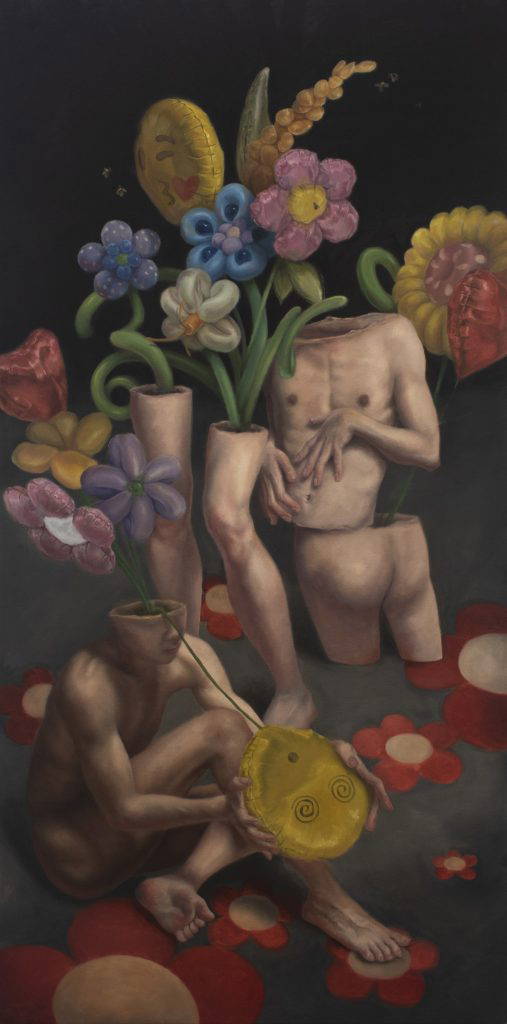
Without totally orientalizing painter Tony Guo’s surreal vaudevilles, it’s difficult not to see the (violently) anxious eroticism of manga comic artist Junji Ito in his work. Like Ito, Guo’s figures suffer from an ecstatic dysmorphia (for example, Gardeners, 2020, a fractured self-portrait in which the artist literally dismembers himself). But unlike Ito the source of Guo’s transfigurations aren’t supernatural entities à la Cthulhu and the body horrors of our cosmically dank origins catching up to us. Rather, Guo’s figures (riffs on neoclassical nudes) are tortured into new shapes by the undulations of social and political coordinates, by the general discombobulations of modernity wrestling tradition (and largely defeating it). For the artist so much of that modernity is diasporic, the psychological sheddings specific to his Chinese heritage scrambling for ancestral nourishment in a strange land (Aotearoa). But also, as anyone with eyes can make out, Guo’s modern discomforts are doubled with his burgeoning queerness. Burgeoning (we can only assume) as it adjusts from one historical context to another, as a typically fraught modality (and of course beyond that, a lived experience). Though New Zealand society is permissive enough, the western lens of acceptable eroticisms is typically white. Here in the Pacific no exceptions are made. It’s no accident that gay desire from as far back as the fifties engendered ‘clones;’ back then, a procession of mostly Caucasian James Dean knockoffs in jeans and crisp white tees, a dandyish iteration of the greaser. And the normative lineage of sexual aristocracy persists today in a steady Les Mills manufacture of corporate-friendly fit wear (with a nocturnal circuit-ready counterpart of jock straps and harnesses; as if the two were not sold separately).
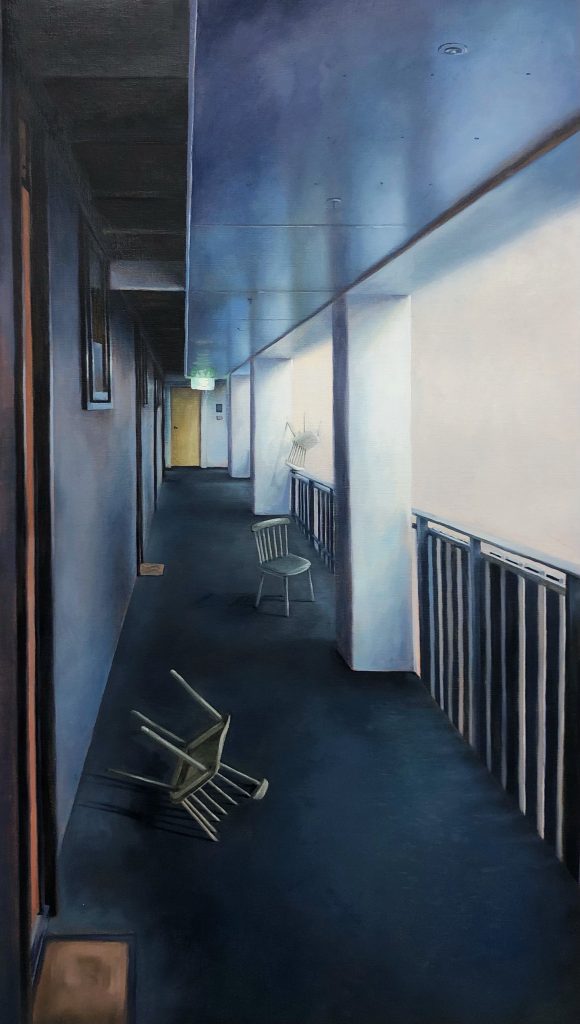
In Walk of Shame (2021) it could be argued Guo strains towards this homonormative light source, uncomfortably. We see what’s presumably a corridor in Guo’s then hall of residence while he was studying at AUT. It’s a work tellingly absent the flesh fairs of Guo’s other frames. Telling because of its title, which alludes to a routine (ritual?) of post-coital abjection, an after-the-fact storm of self-loathing as passion and pleasure fade. The sobriety following a hook up, and the dreaded (but maybe secretly enjoyed) inner monologue of self-inflicted punishment after eking out (night by night) an existence aligned with desire—a desire in flagrant contradiction of (we assume) a cultural and filial milieu. One from which the artist has equivalently cut loose. Untethered. One reality meeting (subjugating; assimilating) another. We see it in Guo’s disarrayed chairs, some of which transgress natural law; one levitates, another blends its atoms with those of the floor, sinking. Gravity disobeys itself here. Form is fluid, porous. And yet the oppressive hallway remains what it is; a tunnel, through which the artist finds himself slouching on a regular basis. Perhaps not just a tunnel, in terms of a narrow lightless catacomb. Maybe also a tract of rebirth and renewal. One which any displaced person must traverse on the way to reknitting themselves in pleasure and power. An intestinal magic, discoveries made while we’re crawling through hopeless spaces—which is also a placental magic.
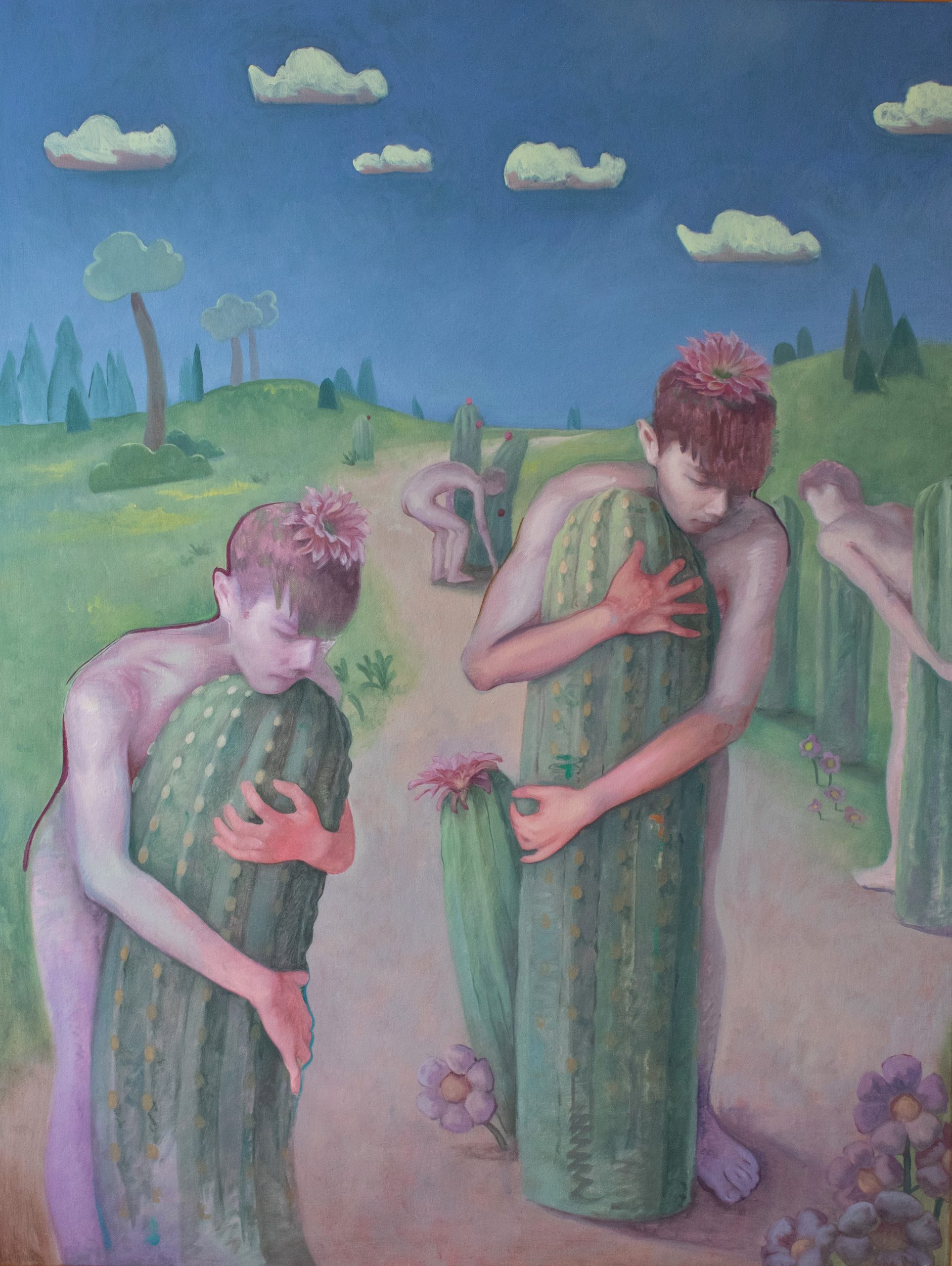
Guo’s gaze here, gathering nubile young men who are possibly duplications of himself, shares something genetic (albeit less frenzied) with Pier Paolo Pasolini’s ‘doubled pornography’ in Saló, the Italian auteur’s 1967 adaptation of One Hundred and Twenty Days of Sodom. In Saló, Pasolini’s sexually enslaved twinks are made alluring in conventional pornographic framing. This is undercut (or perhaps heightened) by a second imperative: the desire not just to see naked bodies in heat—the retrospectively naïve impetus of porn’s Golden Age—but also the perverse desire to see the barbarity of fascism in action. Albeit in deeply fetishized (camp?) tableaux. What Guo shares with Pasolini’s impulse to punish and titillate audiences at the same time is to package (more discretely than Pasolini) a type of violence in visual pleasure. Sometimes this is obvious (again, the whimsical dismemberment of Garden). Sometimes less so, Tilt (2023) for example, in which three or four slutty nudes hug undeniably phallic cacti to themselves. Their expressions of resigned anxiety speak to more than prickly embraces. There’s something Edenic here, a shame in nakedness, a shame in desire for the phallus, a shame in desiring men. On the nose for sure, but it works for the same reasons Saló did—as a pornography unsettled by its own desirous aims, troubled and camp, without, of course, letting camp block Guo’s consistent melancholy. Thwarting Guo’s documents of desire is this specter of sadness, this quiet (tragic?) failure of desire itself. It is arguably this which transcends the specificity of identity and makes Guo’s work more widely relatable—to the yearning human animal.
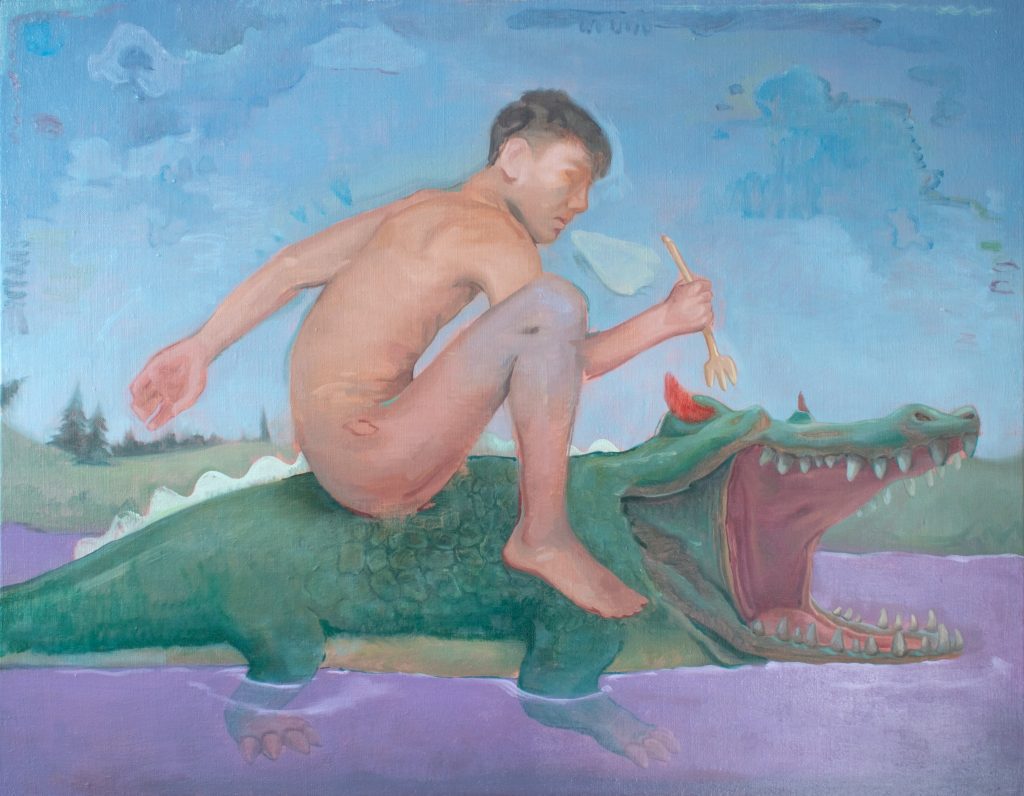
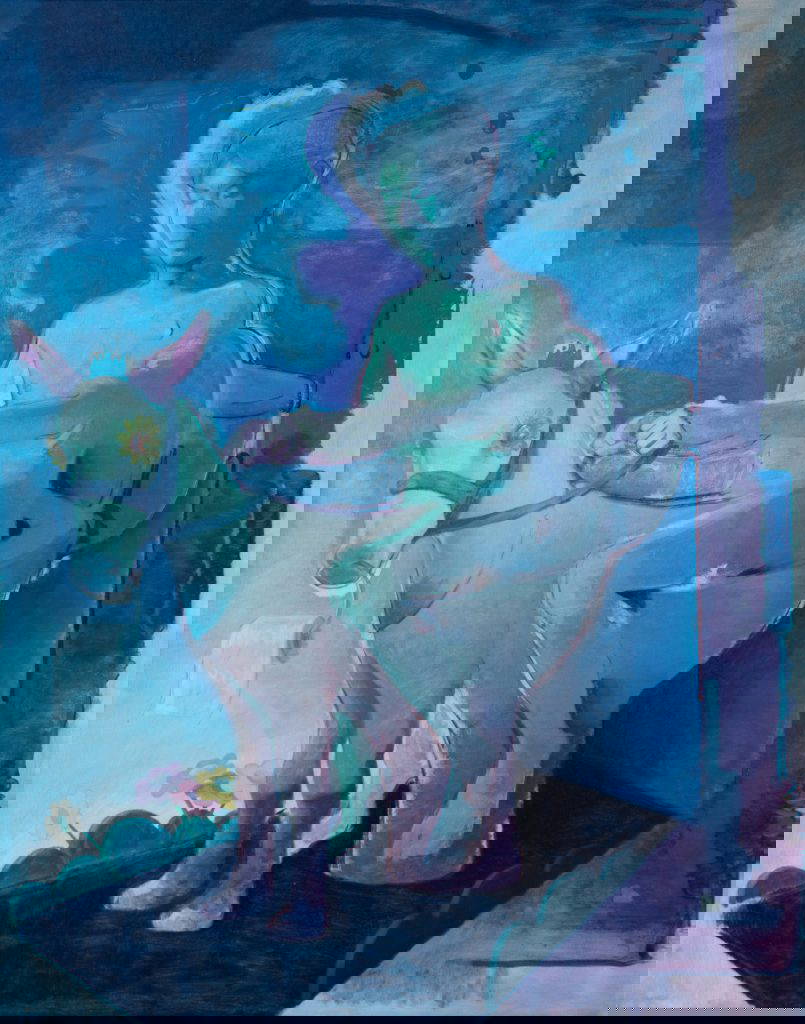
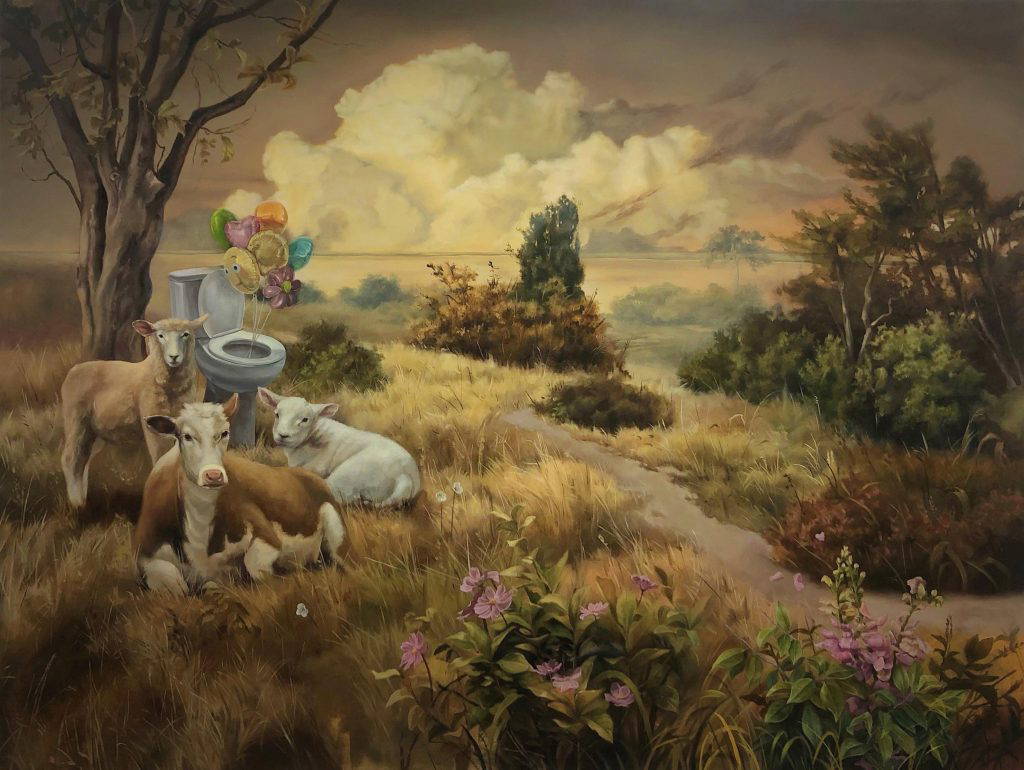
It is no accident then that animals eventually populate Guo’s frames as numerously as his twinks. Animals as chthonic avatars. From sexual anxiety to an uneasy acceptance of the body’s insistent mandates. Uneasy because Guo’s animals are sometimes in harmony with the artist’s figures, sometimes antagonizing, sometimes in strained mutual tolerance. A telling diptych for this corporeal malaise is Plod (2023) and Flush (2024). In Plod one of Guo’s nudes rides a devil-horned alligator, spurring it on with what might be a kitchen utensil. Whatever malevolent (sexual?) hunger this alligator conceivably represents is not so much tamed as temporarily wrangled. Far from skittish, Guo’s bareback twink rides with confidence, with vicious glee. A guiltless body high (for the time being; before post-orgasmic dysphoria, the manic urgency of fucking). The pastoral serenity of Guo’s backdrop here is a key—we are in Nature with a capital N (the inescapable kind). In Flush the artist’s nude rides a donkey that is also, somehow, a toilet. A beast of burden. The perennial labour of eating and shitting. Instead of the embattled triumph of Plod, Flush shows a more somber acceptance of what the body is and does. The horrors of flesh which are also mundane horrors, everyday horrors (the expulsion of waste). Arguably this work is in direct relationship with The Curse (2021), its coda. The Curse sees Guo trying his hand at the kind of russet landscapes you could easily mistake for a frame from an early Terrence Malick movie, only to splinter his pastoral with a lonely commode from which dangles a bouquet of helium party balloons. Around the artist’s toilet sheep and cows rest, staring out from the frame with that uncanny animal stare. Accusing? Perhaps. Flush, then, marks a trajectory from a hostage situation to soiled surrender. From disgust to solemn ritual (which is a kind of peace).
Tony Guo (b. 1999) is a painter born in Aotearoa New Zealand who grew up in Northeast China. He migrated to Tāmaki Makaurau Auckland in 2012 by himself, spending his teen years with host families while adapting to multiculturalism. Vested in modes of figurative oil paintings, Guo explores the intersections of absurdism, embodied history, and queer survival, where moments of whimsy mask an existential anguish.
Samuel Te Kani is a Tāmaki Makaurau-based writer and filmmaker. He likes dick. A lot. His writing and filmmaking reflects that. He also writes critically about art.