The Work of Angels
The Work of Angels by Anisha Sankar. Dead Bird Books (2026). RRP: $35.00. PB, 76pp. ISBN: 9780473772499. Reviewed by Kahu Kutia.
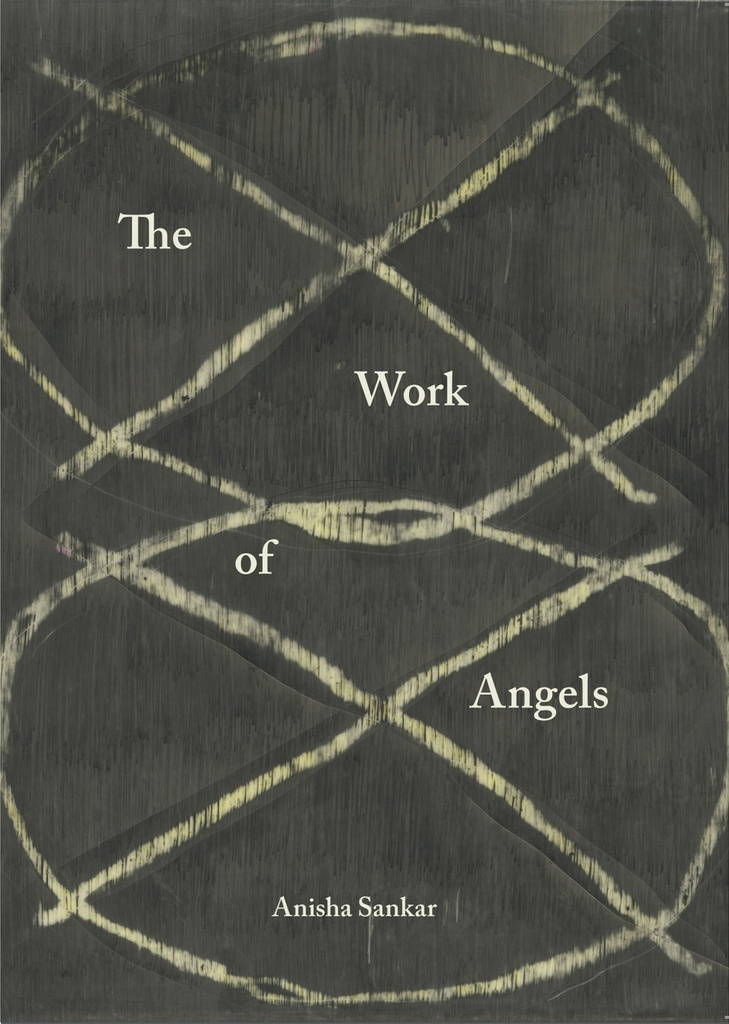
The role of a storyteller is to preserve. This work of preserving is a burden that I often think about in my writing. As storytellers, we engage in the work of knowledge collectors, archivists, painters, wordsmiths, portrayers of words, and creators of historical memory. The voice of the writer becomes the paintbrush by which we categorise and therefore perceive our own history and the path we followed to get there.
In writing workshops, my peers and I have devoted much time to trying to understand the ethics of the power we wield in being preservers of memory. We inevitably feel that to be a storyteller is to be unreliable. The idea that we can store and disseminate knowledge objectively is a myth—a colonial one at that.
An indigenous whakaaro would propose that subjectivity is not only inevitable, but it can be a positive feature of a story. That every whānau, every village, every culture has their own version of something that offers significantly to the idea of ‘truth.’ So we, as the storytellers, are tasked with observing, and doing our best to craft the world from our context.
Reading Anisha Sankar’s debut poetry collection The Work of Angels, the idea of memory and the power of the memory-preserver felt like such resonant themes, in both overt and subliminal ways. The narrator, and therefore I as the reader, seems to feel the burden of being the one who shares the memories. The Work of Angels becomes a tapestry of story, weaving together intimate personal memory with wide historical reference, mythology, and a texture of world that feels mysterious, esoteric and celestial, but also natural, embodied and palpable.
More than anything else, this book left me with a deep curiosity about the narrator—the ‘I’ proposed in the book—and the internal world of that storyteller, how close that narrator is to Sankar as the author of this collection, and what their sense of voice can tell us about the world that is fleshed out across these pages.
This collection inhabits some murky underworld of memory. On the grainy river beds of this world, Sankar is there overturning rocks, allowing themes of desire, colonialism, the geopolitical consequences of extraction, and division to rise to the surface, all wrapped in an aesthetic that feels philosophical and mythical.
This collection offers up nine poems of varying length. ‘Seven Sisters’ presents a series of fascinating vignettes, seeming to traverse time and memory:
‘All memory is a kind of loss that calcifies the false
moment of its object. Perhaps the work of mourning
is no less coercive than any other attempt to consider
the devastation of the rift.’
‘The Work of Angels I’ and ‘The Work of Angels II’ give structure to this collection and inform the shape and context of the work. They are excellent poems. ‘The Work of Angels I’ is impressive in the way it maintains pace and momentum. It holds simultaneously a sense of the formidable width of history, and the immediate, the personal, the daily. There is a line about wind turbines that lends itself to the naming of the poem and the collection and it is so good:
‘A line of wind turbines appear
on the mountain’s edge like waving figurines
as if from a celestial plane we couldn’t see
before this moment. You are mesmerised.
Always attentive to the work of angels.’
‘The Work of Angels II’ moves at a gentler pace and with such a strong sense of heart.
One of the reviews at the front of the book referred to this collection as ‘intellectually dazzling’ and on this point I do have to agree. I had to work hard to access the themes of this book. I had my laptop open next to me, frequently searching up concepts, names and the meaning of words I had never encountered before. I did a deep dive into Walter Benjamin and the ‘Angel of History’—offered up as a reference point by another one of the reviewers in the opening of the book.
I say this to be fully transparent with you. A lot of references in this book flew over my head at the first read. I asked myself if I was the right person to offer a review of this collection. I have never liked a review that states ‘this is good’ or ‘this is bad,’ and I always see this kind of work as a forum in which to seek further wānanga, to be in discussion and idea-generation with the author and you, the reader of this writing, and to gift back some new knowledge or perspective. As a queer indigenous writer, I do engage with this collection from some mutual sense of the world.
As I worked and researched my way through understanding the world-building of this collection (which is undoubtedly impressive and frequently beautiful), I wondered about the tension between access and the advancement of ideas. It is one of my primary frustrations with a traditional academic vocabulary and discourse that the knowledge generated within those contexts are often inaccessible to the communities who might benefit most from that knowledge. Often these are the communities from whom that knowledge was extracted in the first place. These are communities who have borne the brunt of colonialism, racism and other oppressions.
On the other hand, I debated the influence of fascist anti-intellectualism on our current world, especially within arts and western pop culture. It is important for creative and intellectual works to push us uncomfortably and unapologetically to new places. It is a good thing for me to learn the meaning of the word ‘usufruct.’ I guess in the end, my curiosity returned to the voice of the narrator, and wondering who this book is for. And it is totally ok that this book maybe doesn’t posit me as the primary audience. There are still many gems through which I can wade in discovering the world of this collection.
One of the standout poems for me was ‘The Weight of Stones.’ Here, the sense of mystical world-building and history blend so beautifully with what seems like the real embodied memory of the author. I love to read poetry as a potion. Each word is an ingredient that contributes to the overall power of the elixir. In this poem, each word chosen feels so impactful. The cadence of each stanza carries a lovely pace. The overall texture of the poem makes me think of the quality of powerlessness we often feel in a dream, unable to precisely control our movements. But also dreamy in the sense of the subliminal. I thought of fish in a very Piscean way, of water, of The Moon in tarot, of rocks and seafoam and of the toddler at the mercy of waves and parental figures on the shore. I felt both nostalgia and a kind of fear or horror? The fear that comes with realising you are not in control.
To be a storyteller, especially if we think about the Angel of History, is to inhabit a kind of nostalgia, as well as a kind of horror. We as writers can in our real daily lives observe an event and perceive both its beauty and its tragedy. That’s the main feeling I felt at the end of this collection. That poem—‘The Weight of Stones’—ends with the following lines, which tie this collection together:
‘here we find ourselves boundless, too empty, too full
a state about which we cannot draw any conclusion
about which we cannot say: it’s like that’
Nei rā he tamāhine o te kohu e mihi kau ana. Kahu Kutia (she/they) is a queer writer, artist, storyteller and general haututū who was raised bilingually on her homelands of Ngāi Tūhoe. Across all mediums, whakapapa, whenua, notions of kāinga, and connection are often central to Kahu’s work. Kahu has published writing across publications such as The Pantograph Punch, Turbine | Kapohau, Te Awa o Kupu, Te Whē ki Tukorehe, Re:, Bulletin, Your Weekend, and for DK Books.