The End and the Beginning
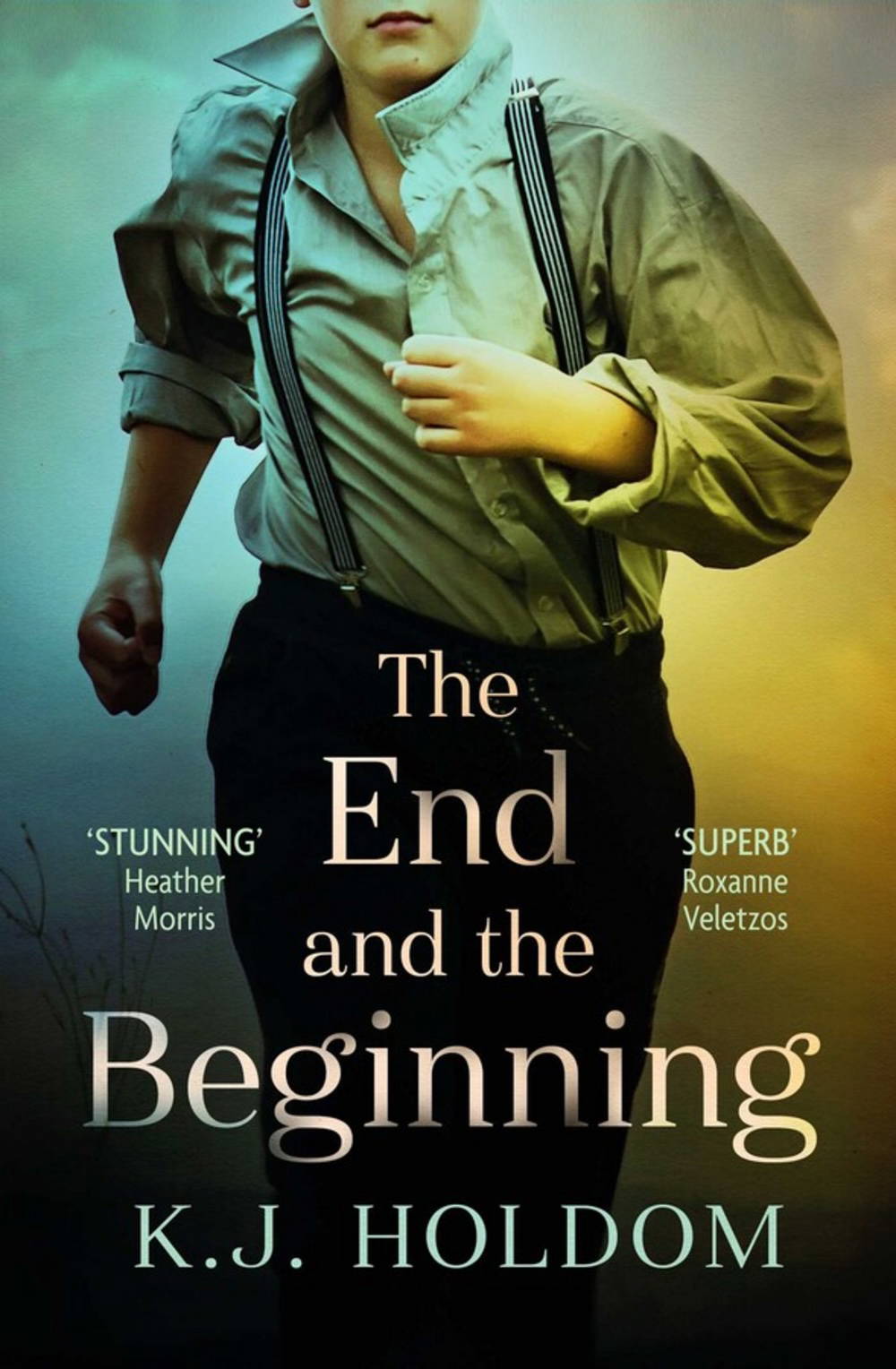
The End and the Beginning by KJ Holdom. Simon & Schuster (2026). RRP: $39.99. PB, 352pp. ISBN: 9781668236925. Reviewed by Jessie Neilson.
The sense of inevitability, circularity of history, and impending doom is intimated in a seemingly innocuous image midway in the aptly-named The End and the Beginning. In this novel set in a small village poised between German and French borders in World War Two, the rural setting is prominent. While the Russians are progressing on one front, and the Allies on another, nature meanwhile is going through its cycles. However, it is not untouched.
‘The mantis makes its slow passage along the length of a branch. Nothing for you out there, poor shortsighted creature. Just a precipice hovering over a sea of knives.’ This metaphor is fitting in the Lauterbach villagers’ case, where they are damned if they do and damned if they do not. Caught between two borders in the Red Zone, many hold dual allegiances. They can try to hide, but it will make no difference. The Bernot family at the heart of the story is just so: father Anton, a miner, is German, while wife Marguerite is French. Their children Maximilian and Anna are both yet also neither, in this wartime where bloodlines and purity are everything. Their lives are held in miniature, halted, each singular life or death paused by universal violence.
The children are alternately termed the neutral Saarfrench, Westwall Gypsies, good little Germans. More insidiously, they are called out as Pimpfe, ‘little rascals,’ members of the Hitler Youth, or even Werewolves, guerilla children of the Reich in its dying days. Unsurprisingly, their personal sense of identity, their political and familial allegiances, and their morality, is dishevelled. Of their family, Anna is the sole victim of fascist brainwashing, and in these formative years she struggles against this, where ‘Hitler had soaked into her skin, her bones, her head, her heart.’ What they do all hold sharp and clear though is the threat of danger: they understand too well how their lives are balancing on the edge of pain and loss. At certain moments, they stand outside of themselves to observe, such as when Max stares down an ‘air gangster,’ a historical snapshot seared into his being.
Metaphors run thick through this young family’s struggles to survive with ethics and goodwill intact. Cruelty is everywhere and the mother and siblings, who the reader follow closely, employ metaphors in their imagination where it is safe to express. Teen Max is angry at almost everyone, unable to trust, as he attempts to journey back home to Lauterbach with his best friend Hans.
A Nazi doctor subjecting him to a racial hygiene test has shiny bird eyes and Max would like to send forth a Zeppelin into the doctor’s glasses and push ‘explode.’ Nazi youth leader Gruber too has animal eyes, this time weasel ones, and a rattish look, and Max imagines him choking on a moth. Nature is implicated and cannot stay clear of the historical scene.
Usually his retreat into resentful imagination is because words are too dangerous, but it can also be that Max cannot find them. He has three languages from which to choose—the third being the Platt dialect—but as for explaining actions to his mother, shame and other emotions run too deep.
Marguerite conjures up comforting delusional imagery set in innocent nature when reality is too devastating. This technique allows her to carry on. She pictures her absent son, peacefully asleep in a warm outdoor bunk nestled into trees, far from the fighting, ‘tucked in a cocoon of feathers.’ Yet her thoughts also turn dark as she imagines her daughter in danger from Karl Hinckel, their Nazi kidnapper. Asleep, Anna would be like a maiden in a dark tale, ‘while her pale throat and steady heart are wide open to the assassin’s knife.’
Anna likewise retreats into her imagination when she is unable to express herself and also turns to nature, seeking out herbs for the local apothecary, yet it is hardly enough to ‘stem the ocean of blood spilling.’ Her lively inner world differs from her brother’s revenge imagery and her mother’s alternative scenarios and is instead more grounded in the world of flora. Encouraged into botany, she has grown to become her mother’s ‘petite botaniste.’ The concrete manifestation of this is the greenhouse attached to Hinckel’s appropriated estate. While she cannot control human-instigated chaos, she can work her magic with plants, nurturing them, and offering their medicinal qualities to her loved ones. With this sense of purpose and of seeking healing, she too is able to carry on. Psychologically she calms herself in extreme moments of stress by reciting her plant alphabet.
Through the novel, we follow the two simultaneous narratives, of Marguerite and Anna kept captive at Herr Bereichsleiter Hinckel’s bolt hole, and Max and Hans’ travels westwards across southern Germany from their relocation camp in their attempt to reach home. As we do so, we notice motifs, drawn from their personal situations, which work themselves into the characters’ psyches and will not let go. This is especially noticeable for Max, in the image of numbered eyeballs in a box, derived from his racial hygiene check, and in his ancient coin, gifted by beloved godfather Charles.
While Max is being assessed by the Nazi doctor, the 16 numbered eyeballs seem to watch him in alarm. The experience is unnerving and adds to his discombobulated state. Later, while at a train station, he sees liberated concentration camp survivors. They are ‘a row of marionettes’ in prison garb, living stick figures, with lidless eyes and smiles like black holes. Bits of people haunt him, eyes particularly telling.
Max notes ‘a flat haze’ of nothingness in Charles’ eyes, in the moment before his death. Later he imagines Charles’ eyes, and his dog Argos’, filled with soil. They are like the mantis, who have fallen off, into the sea of knives.
Even his living friends are not safe from the world of disintegration. Hans’ eyes also turn into black holes. When Max interacts with an American soldier, the first black man he has met ‘in the flesh,’ he is horrified by the man’s eyes, which resemble one of those in the box.
The ancient silver denier, introduced to us in the prologue, begins another motif which preoccupies young Max, but this one holds positive associations. He keeps the coin close, on his person, to bring luck. It is now eleven centuries old, and he knows it far withstands all historical events, while it silently bears witness to them.
The entire novel, both in its two simultaneous narrative threads and in the italicised retrospective section in which we are privy to extra information, is drenched in metaphorical language. At times the weather descriptions are overdone, the repetitive descriptions of extreme highs and lows fatiguing. They are, however, ripe with imagery so we can imagine how characters battle through it, especially when crippled by hunger. In his delirium, Max experiences the train crawling into fog as if they are ‘knocking their way through the ribs of a colossal white beast.’
We also see the interplay of the natural and humanmade worlds, where boundaries are ambiguous. There are the ‘metal locusts’ in the sky, heralding death—P-51 Mustangs ‘grim birds of prey,’ and agitated wasps. There is the return to nature in the devastating image of a dead child as a ‘little brown nut dried up in its shell.’
Sometimes inanimate objects or elemental states betray our protagonists. Where we might expect neutrality, there appears instead a ‘murderous’ sky, a ‘monstrous and rust-coloured’ moon, dirty light and a false sun. When bomber planes drop thin threads of chaff from the heavens ahead of attacks, the children below are illuminated like ‘saints on the street.’
The house taken by Hinckel is no longer innocent. Though it is pink and cream and looks like a layer cake to Marguerite, with half-lidded windows, perhaps seductive, it has transformed into a place of evil.
Yet at times the heavens redeem themselves, promising salvation: there are the gold-washed skies of Bavaria, and gold spread like the light of angels. There is a lovely image of rain-soaked foreigners shining like gods.
K. J. Holdom’s historical fiction is brimming with inventiveness. To aid the reader’s progress alongside the characters, set against the backdrop of a quickly changing Europe in dire straits, she includes maps at the beginning which chart the boys’ journey. This is helpful, especially since the action takes place throughout small towns and where borders blur.
The medieval setting in the prologue is also intriguing, with a back story which could have been expanded at the end as Holdom links up Max with his coin, the passage of time, and the circularity of history.
Characters in The End and the Beginning are fully formed and realistic, whether showing the goodness at the centre, or those full of hypocrisy and betrayals and devoid of humanity, as seen in surrounding antagonists. However, some names are confusingly similar, so early on one must try to identify who is Hans and who is Horst, and likewise with prominent fascists, Gunter and Gruber.
In her epilogue, we learn that the narrative has a real individual at its heart. Edmund Baton, to whom she dedicates her novel, was a young boy sent to a camp, just like Max. Her detailed recounting at the end, plus the photograph of an innocent young boy, and her subsequent real-life interactions with his descendants, make her novel all the more compelling. Just as identity for these characters is fluid, so too is the movement of time and distance. We have a very real sense of ends and beginnings revolving and flourishing, or wilting, balanced on precipices of grand historical upheaval.
Jessie Neilson is a Library Engagement Assistant at the University of Otago, where she studied English literature. She regularly reviews for the Otago Daily Times, and occasionally for takahē and Kete Books. She has wide interests in things literary.