Portrait
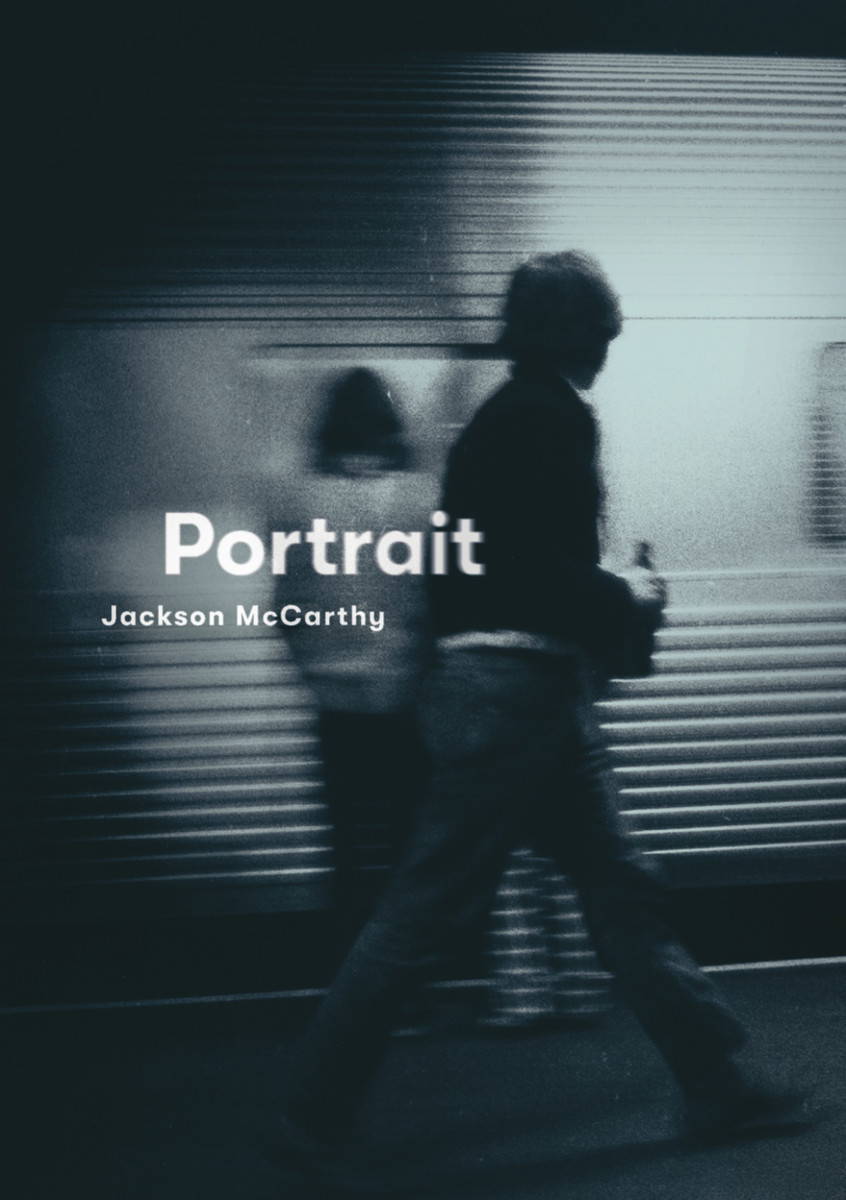
Portrait by Jackson McCarthy. AUP (2026). RRP: $25.00. PB, 68pp. ISBN: 9781776712304. Reviewed by Niamh Hollis-Locke.
Boasting endorsements from the likes of Anna Jackson and former Poet Laureate Chris Tse, Portrait is a stunning debut that establishes McCarthy as a serious poet who can go toe-to-toe with the best of them. Characterised by a maturity of voice and lightness of touch impressive for a poet still in his early twenties, this is a strong collection of lyric poetry that more than lives up to its hype.
Throughout the collection, McCarthy plays with the distance between implied author and real poet, and the inherent artificiality of the poem. ‘The mode [of Portrait] is confession,’ says McCarthy, in an interview with NZ Booklovers, ‘but the poems are not me because I’m a person and they’re poems.’1 Indeed, the poems in Portrait appear to reveal a lot—intimate moments shared with past lovers, desires, fears, time moving forward and the poet growing older; all things one expects from good lyric work—yet we are left with the sense that we know very little about the person who wrote them. McCarthy frequently reminds us that we are only shown what he wants us to see; Portrait is full of lines that emphasise the nature of the poem as a performance, and the poet often makes eye contact with us in ways that feel like a challenge. In ‘Adam,’ the second poem of the collection, McCarthy writes ‘[…] a crowd had gathered like black water / to hear these: my innermost thoughts.’ Here, the speaker turns and stares us down, reminding us that he knows we are watching. Consuming poetry can often feel like a rather voyeuristic act, but, McCarthy reminds us, we are also fundamentally a paying audience and the poet holds the power to decide which versions of himself to present.
Elsewhere, McCarthy foregrounds himself as creator, interrogating the relationship between art and artist. This is most obvious in ‘Uniform,’ one of Portrait’s strongest poems. Here, McCarthy performs a rather complicated little trick, writing:
‘behind us, watching, was Jackson McCarthy,
noted homosexual. Eater of olives. Writer of poetry.’
This ‘watching’ McCarthy is both the speaker’s future-self, and, I suspect, the most real version of the poet in the entire collection. By placing the poet inside of the poem with his subjects—and I would argue that the speaker is just as much a subject here as the people the speaker describes—McCarthy firmly differentiates the speaker from himself. The epithet ‘writer of poems’ is fairly load-bearing, emphasising the poem and its speaker as a contrivance separate from the real McCarthy and his life. As McCarthy puts it at the end of his prose poem ‘The Visit,’ ‘Life is real, art is fake. It was a stirring mantra that revealed a simple truth. But I had already written the poem.’ This is a clever manoeuvre, and Portrait is a clever book.
With a book titled Portrait I find it difficult not to think of James Joyce, or want to fill in the blanks with ‘of the artist as a young man.’ In this case I suspect the implied ‘of the artist [etc.]’ is supposed to be there, like a ghost note, heard and not heard, seen and not seen, much like the artist himself; McCarthy is present in the poems, or behind them, but only as representation and reflection, shaped by our reading of him as much as the author’s idea of himself, and as elusive and transitory as the blurred figures on the collection’s front-cover. It is perhaps no accident that the word ‘subject’ is used multiple times throughout the collection—and that is ‘subject’ in the sense of the focus of a painting, or of a specific area of study. ‘I made pacts with myself, / my best subject’ writes McCarthy in ‘Santa Monica (1)’; later, in ‘Landscape,’ the speaker reflects on a time when ‘cruelty, then, / was not one of my subjects.’ The facets of the self are the focus of interrogation and re-presentation, with the unspoken suggestion that the writer of these poems will, at some point in the future, become the subject of other poems himself.
Portrait is marked by a double vision of sorts, looking ahead and behind simultaneously so that time often appears less like a river than a lake. In many poems, past and present are pressed cheek to cheek, as close as entwined lovers; in ‘Santa Monica (4)’ McCarthy writes, ‘Harry, / it’s been the past / again,’ while in ‘Three Mysteries: 3,’ present and future compress as the speaker falls into sleep ‘and with it the coming day / where I’ve been walking endlessly, thinking of you.’ I appreciate the way McCarthy trusts his reader to figure things out—or at least does not seem concerned about whether or not they will understand him. He wastes very little space spelling things out, and this extends across the collection. Biblical allusions and references to classical mythology are relatively standard poetic fare, and, as with many other Aotearoa writers, McCarthy also employs Māori mythology for the same ends. In Portrait, mentions of figures like Pania and Mahuika are as matter-of-fact as references to Samson, and carry with them the same expectation that the reader will either understand the reference or be able to work it out for themselves.
There are a few rough patches within the collection. Some of the poems are rather frictionless and therefore almost too digestible, while others come off as overwritten—‘Music’ and ‘The Earth’ in particular feel as if McCarthy is trying to prove himself a poet by mentioning all the right stuff, and are the weaker for it. However, these are rare exceptions in what is otherwise a consistently strong debut. I’ve been fortunate enough to be acquainted with Jackson McCarthy’s work for a while now, and when Portrait was announced it went straight onto my to-read list. If you enjoy good poetry I recommend adding Portrait to yours, too.
1 “Interview: Jackson McCarthy talks about Portrait.” Web. June 11th, 2026. https://www.nzbooklovers.co.nz/post/interview-jackson-mccarthy-talks-about-portrait
Niamh Hollis-Locke lives and writes in Te Whanganui-a-Tara. Her work has been published widely in Aotearoa as well as overseas, and in 2023 she was shortlisted for the Ginkgo Best Poem of UK Landscape award. She was the guest-editor of Minarets 14 (Compound Press, 2024). Niamh holds a BA and BA(Hons) in English Literature, and a Master’s in Creative Writing specialising in ecofiction.