My Bourgeois Apocalypse
My Bourgeois Apocalypse by Helen Rickerby. Auckland University Press (2026). RRP: $25.00. PB, 80pp. ISBN: 9781776712106. Reviewed by Dani Yourukova.
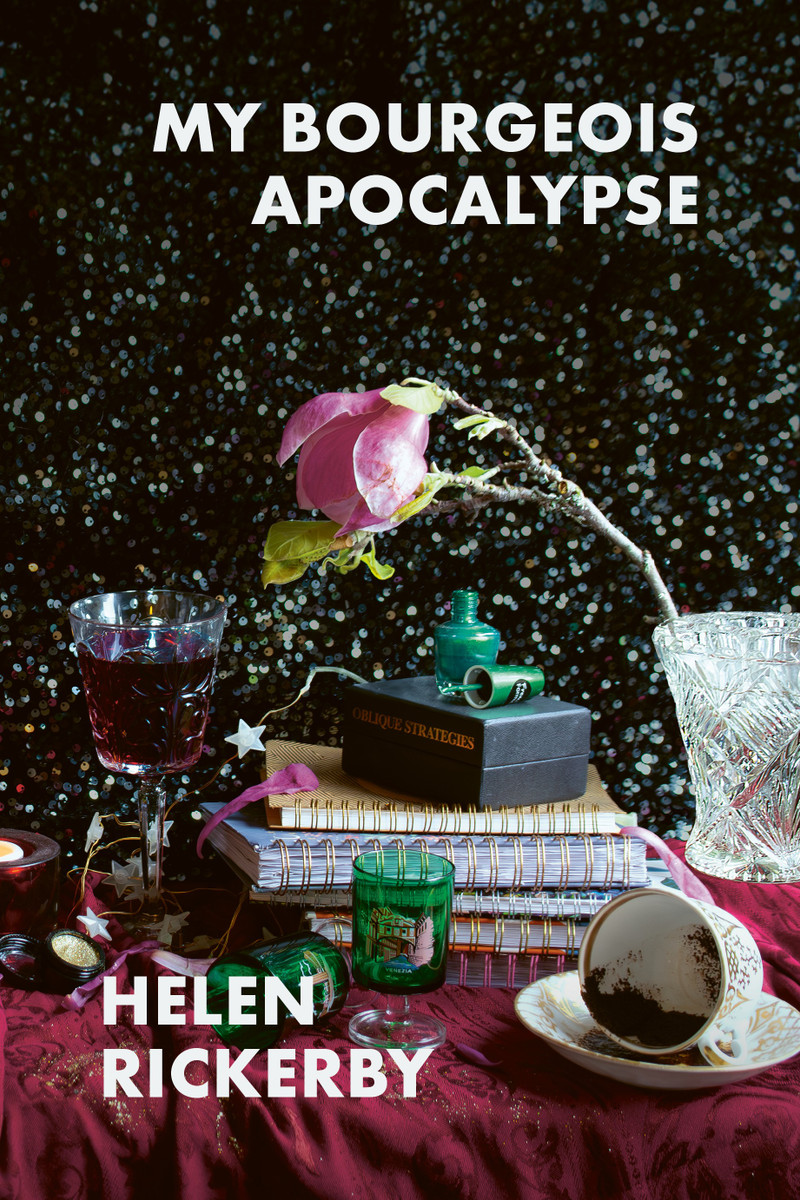
‘Poets, like architects, love contradiction and near incoherence.’ So reads one of the two Elisa Gabbert quotes that provide the epigraph to My Bourgeois Apocalypse, Helen Rickerby’s eclectic new ‘poetic-memoir’ made with extracts from her own diary between the years of 2019 and 2024. Incorporating personal narrative, Italian lessons, literary quotations, pop music, and parties, the book weaves and layers disparate elements to create something multifaceted and unexpected. I don’t know any architects, so I am unable to verify if we share fundamental aesthetic preferences, but Rickerby’s love of contradictions, disruptions, lyrical digressions and elusive characters will certainly please the poets.
I find myself hesitating over the blurb’s evasiveness on the topic of form. On the one hand, My Bourgeois Apocalypse resists typical genre classification; the particularity of expression is entirely Helen’s own, and the book as a whole is committed to leaving room for contradiction and doubt. So it feels antithetical to the project to want to tie it down to being one particular thing. On the other hand, it’s illuminating to know that Rickerby is writing into a vibrant and specific literary tradition. The form (which Rickerby co-hosted a brilliant conference on late last year) is what Emma Winsor Wood calls ‘the Lyric diary’:
‘Sometimes called a novel, sometimes an essay, sometimes a memoir, sometimes a poem, the lyric diary is a slender volume in which a first-person narrator records experiences alongside facts, ideas and quotations. The lyric diary refuses the narrative arc, instead taking on the lyric’s associative logic as well as the diary’s serial, episodic movement.’1
That sense of serial, episodic movement is carefully attended to in My Bourgeois Apocalypse. For example, the dates that bracket the action of the book have the front and final pages entirely to themselves. ‘February 2019–’ and ‘–October 2024,’ a time frame that can’t help but raise a torrent of apocalyptic associations: extreme weather events, genocide reporting, a pandemic. The convention of dating the text is a standard one for a completed journal or diary. It also suggests that the contents are in sequence. Each lyrical fragment too, is numbered, as if it is part of a list. Carefully, carefully, the book reassures you: you are travelling sequentially from one thing to another.
But within the fragments, that movement and its relationship to time is unpredictable. The text lilts from thought to thought, anecdote to anecdote, seeming—at first—like it might be confessing something intimate. And there is, admittedly, a great sense of intimacy and intensity in this book. Then, all at once and unexpectedly, the text shifts. A pronoun, or a location, some other morsel of detail slips, and you are ungrounded. Time and identity are slippery. You have followed the text’s shining lures and now you are nowhere near the place where you first supposed yourself to be. Because, on closer inspection, despite all of its recognisably diaristic gestures, My Bourgeois Apocalypse keeps its secrets as often as it confesses them:
‘I write not to communicate or reveal but to mull and conceal, but I guess that’s a form of communication too, of connection, of little anchors, little hooks, little holes you can put your eye up to, your heart up to, and maybe you will see something you will recognise.’ (‘#34 (when I got so panicky about the building work that we had to move out of our house for a couple of weeks)’)
Each lyric fragment is titled in brackets, as if the title were a private aside, or a secret. The body, too, moves as if it is full of parentheses, asides, and digressions. There is a great deal of lyricism here, but also sentences that feel deceptively raw, as if the reader is being granted access to a stream of spontaneous consciousness. Take the following example:
‘Because this is what I often do, I’m thinking about you, considering if this idea relates to us—close but never solved, never complete, never accurate. I don’t think it is what’s happening with him, though I find I prefer it to my own interpretation. Is it all just chemical?’ (‘#1 (a sort of prologue)’)
Surely, ‘I am thinking about you’ must be one of the all-time poetic sentiments. Close but not quite. Another person just out of reach. The complexities of interpretation. I suspect that these are the preoccupations of diaries too. When I suggest that this sense of ease and spontaneity is deceptive, I am gesturing towards the details. What, for example, is happening with that shift in pronoun? ‘You’ and ‘him’ seem ambiguous at first, likely to be different people on closer inspection, which suggests a more complicated cast of interconnected characters and relationships, quite different from a straightforward, directional yearning between lover and beloved.
‘When they were leaving I hugged both of them and kissed them on the cheek, and then, after he’d started walking away, he turned and blew me a kiss. I do not have precise control over my eyes, my looks. We’ve been swimming every day at Worser Bay in the late afternoon. Why would I have found myself holding your hand, unwilling to let go? Someone told me once that menopause was just like adolescence, and the last time I was stuck in a situation like this – well, I was adolescent.’ (‘#1 (a sort of prologue)’)
The emergence of ‘we’ and ‘they’ mingles pleasingly with the continued mystery of ‘you,’ a mystery that only deepens as a cast of defined characters emerge throughout the book. ‘He’ and ‘him’ may start to feel continuous. Other characters might be named in full, or initialled, or defined through relation to the speaker. Doubt creeps in with every assumption. And always we are left to construct the ‘you’ in the spaces between. Which brings us back, I suppose, to the keeping of secrets. I associated the diary with confession earlier, but really, if you imagine that there are two extreme points at either end of the continuum of confession, the diary sits at both extremes simultaneously. The diarist is free to make total, intimate disclosures because of, and in relation to, the expectation of total privacy. There is a reason that diaries for young women are sometimes sold with a lock.
‘It’s not that you can’t interpret a poem, but it’s not quite like a one-for-one decoding—perhaps it’s like interpreting a dream? I want to be a light you want to fly into. This is my favourite way to love—completely.’ (‘#38 (the freedom of randomness and chance)’)
Diaries are not only permitted to be intimate, but trivial, personal, domestic, maybe a little self-indulgent. It’s a form that, by its own private nature, is easy to discount, or deny keeping. When the keeping of a journal intime rose to popularity in early nineteenth century France, it was considered ‘un-literary, un-productive, and a suitable occupation for women’ (Winsor Wood, 2024). So what does it mean to make a diary that is lyric, public, and so consciously literary?
Well, I would argue that it unlocks an enormous amount of fresh possibility. Rickerby’s formal play between confession, withholding, and doubt translates some of the intrinsic joys of diary-keeping into poetic form. My Bourgeois Apocalypse takes seriously and celebrates a form of women’s writing often relegated to the outskirts of acceptability. It’s passionate, expressive, yearning, grieving, curious and wise. It revels in the many facets of what it means to connect with another person, and often you feel that you are close, so close, to encountering something that feels like revelation. But trying to uncover its secrets is a bit like cracking open a disco ball: enormously pleasing, unlikely to work, and not entirely the point. The magic happens in the way the light reflects, like a thousand little mirrors, shimmering in the dark.
1“I am not a melodramatic person”: Defining the Lyric Diary, (2024), Emma Winsor Wood. https://www.tandfonline.com/doi/full/10.1080/14484528.2024.2332600
Dani Yourukova is a poet, reviewer, and amateur occultist. Their poetry and essays have been published in places like Sweet Mammalian, The Spinoff, bad apple, and Turbine | Kapohau. Their debut poetry collection Transposium was published by Auckland University Press in 2023.