Lucky Creatures
Lucky Creatures by Joseph Trinidad. THWUP (2026). RRP $35.00. PB, 264pp. ISBN: 9781776923090. Reviewed by Vaughan Rapatana.
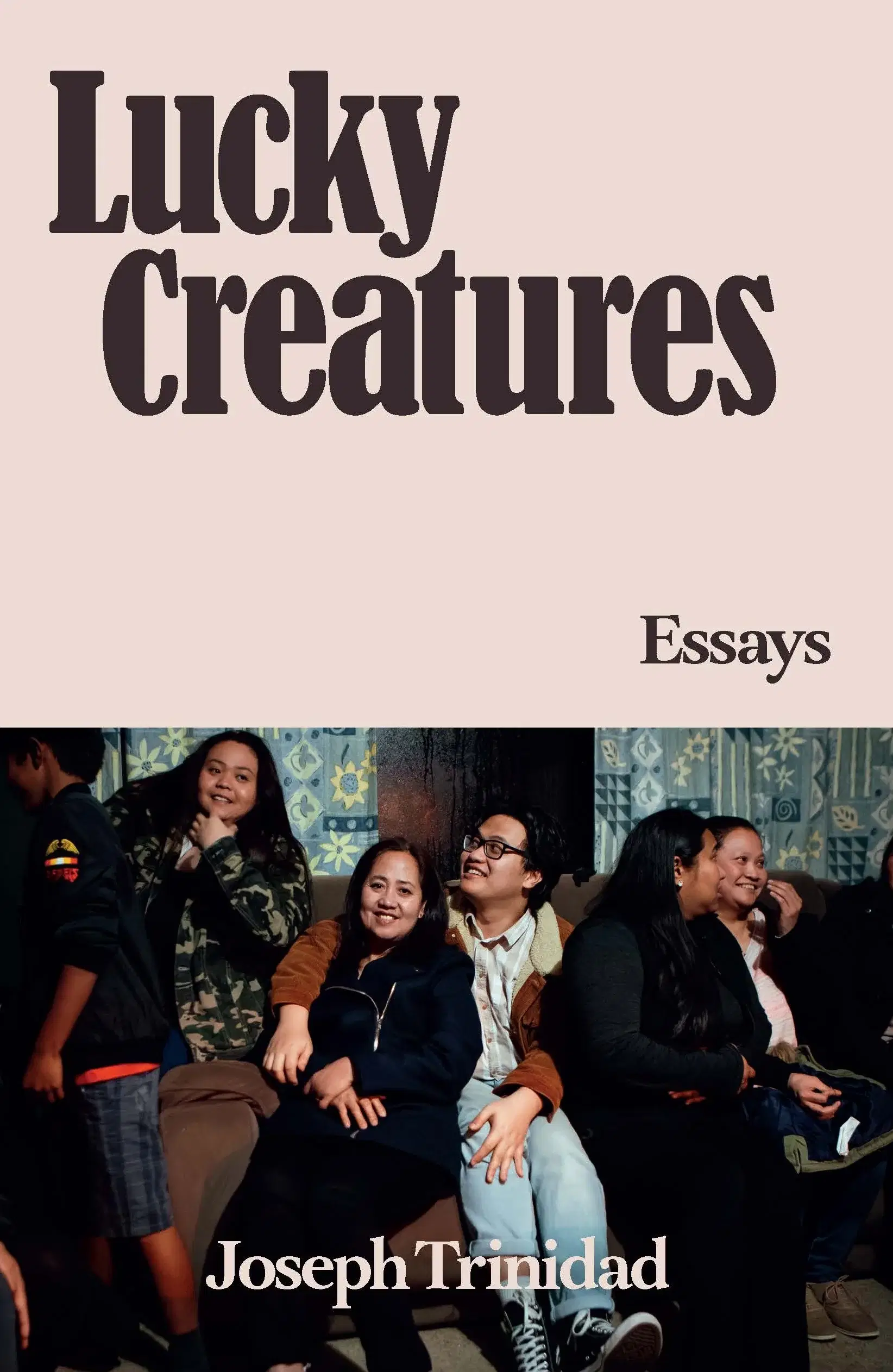
I will come out and state this right now: Lucky Creatures is an outstanding compilation of thirteen autobiographical essays. These are chronologically arranged to trace the life of Joseph Trinidad from his upbringing in Luzon, Philippines to his—and his pamilya’s/family’s—educational and vocational experiences in Aotearoa New Zealand, and then back again to his homeland to visit the mausoleum of his Papa, the cherished grandfather who was so influential in his early years.
A full circle if you will, but the circle remains incomplete because Trinidad is still a young writer who will indubitably have much more to share, to entertain and regale us with via his graphic portrayals, his humour, melancholy, and constant honesty delivered by clever, creative writing—albeit often in Tagalog. Trinidad is an original voice, especially in this Antipodean landscape.
Now, as we travel through the arc of these expositions on growing up across two cultures, it is as if there are three distinct stages to the journey.
Firstly for me—because I am balikbayan, meaning I can enter and remain in Philippines as my wife is Filipino, and we return frequently to our family home in Santo Tomas, Pampanga—the depictions of Trinidad’s early years in Laguna are just so well depicted that I feel as if I am back in provincial Philippines with its myriad distinctive tastes, sights, smells, incessant movements, and mentions of Jollibee. I found myself laughing so much I had to put this book down to reflect happily on my own travels across the Philippines, where I first went in 1980, or to read out long passages to my asawa (wife) to share.
The second section relates the Trinidad whānau travel to and initial settling into rural Hawke’s Bay, where Trinidad’s father moved to work on a dairy farm years prior to his wife and two children following him. Why did Trinidad senior do this, why did he become an OFW (Overseas Foreign Worker)? Simply and necessarily, to make more money than he ever could in Luzon, so as to finance the education of his anak (kids) and to ‘build a better life,’ although the longer their saga continues, the more that latter cliche is an arguable one. Are their lives ‘improved’ by the move?
The essay titled Grace at the Farm, in which Trinidad becomes his mother, in the sense of seeing and comprehending her/their new start in rural Hawke’s Bay through her eyes, is quite brilliant. Trinidad captures the angst of a Filipino who arrives in this country and immediately is forced to adjust to the complete lack of vibrancy and indeed of people in their vastly different new setting. From being a well-qualified university professor in her homeland, Grace becomes a worker in the fruit and vegetable division of the local New World supermarket, compelled to speak and communicate in English. Indeed for her to even attain a teaching position in this country required Grace to pass an IELTS minimum examination score of 7.0 and she refused to attempt this, primarily because of the way the English language agencies hold indigenous tongues hostage globally—‘She has long since given up trying to please a country that treats her native tongue as a prior conviction.’
I completely empathize with the initial and continued plight of Pinoy who travel to New Zealand and ‘end up’ working slavishly on remote dairy farms, alienated from wife and children back home, and bereft of favourite pagkain (food/kai) and media enjoyments such as watching Eat Bulaga and Showtime—although the latter situation is improving as the increasing wave of Philippine workers apply successfully for work and educational visas here, becoming permanent residents and then citizens as they remain in New Zealand.
This second section remains rather different as regards the diminished humour and happiness compared to Joseph’s formative years back home, a mood that permeates his coming as bakla and bading (gay men), and his adventures in the ‘queer’ world, including his wistfulness about not being able to easily be a parent with his partner Max. More angst for this Filipino expatriate.
The final three essays bring the reader more up to date and we learn via a fantastic FaceTime chat with his deceased Papa that Joseph years previously had a breakdown, that he married Max, that Papa was taken aback when Joseph revealed that he is reasonably happily gay—or should that be reasonably gaily happy—about his life nowadays. He also elaborates that he strongly misses his Papa, a point further stressed in the final essay where Joseph, his sister and his mother return to Laguna and visit the mausoleum which he had never been to before. In fact Joseph aka Gian—which is his given name but which he is not called in New Zealand because his Kiwi teacher could not pronounce it—did not attend Papa’s tangi years previously because he would have failed his tertiary examinations if he had balik (returned to) Philippines and had instead hoped for a special circumstances pass.
There is considerable pathos conveyed across this final sector, yet there is also a largesse of humour and irony during the FaceTime chat and in the chapter whereby the pamilya fly back home, making sure that they have many pasalubong (koha) to spread amongst the vast swathe of cousins back there. And the poignancy and also pathos conveyed by Trinidad after his fifteen year absence from being back home hit me hard too, especially when he describes their arrival at NAIA airport and then their syncopated drive back to their family home, that of Mami—his loving and lovable grandmother. ‘I am estranged, yes, but I am willing to know and be known again. This is my house; it has not been replaced,’ muses Gian aka Joseph.
All credit to Gian Trinidad and Te Herenga Waka University Press, then, in gifting us this collection, a vital enunciation of the realities of being a Filipino becoming a Kiwi Pinoy and the innumerable exigencies involved, the stark actualities of and differences between the two cultures, and the concomitant difficulties of living across them.
My only slight issue—although I did wonder why Trinidad did not mention asuwang anywhere—is that the amount of Tagalog sprinkled throughout the text may well confound the ‘average Kiwi reader.’ That was not an issue for me as I am reasonably fluent in the tongue—which incidentally has several strong echoes of te reo Māori. Then again I also surmise that Lucky Creatures is destined as much to attract overseas readers, and to appeal mightily to the multiplying throngs of Pinoy (sometimes termed Kiwinoy) arriving here everyday.
Maraming maraming salamat po mga kaibigan.
Vaughan Rapatahana (Te Ātiawa, Ngāti Te Whiti) commutes between homes in Hong Kong, Philippines, and Aotearoa New Zealand. He is widely published across several genres in both his main languages, te reo Māori and English, and his work has been translated into several other tongues. He is the author and editor/co-editor of over 50 books. His latest books, all published during 2025, are Sexual Predation and TEFL (De Gruyter Brill) and the co-edited anthologies Te Moana o Reo | The Ocean of Languages (The Cuba Press), and Te Pūrere/The Exodus (Cold Hub Press).