Giving Birth to My Father
Giving Birth to My Father by Tusiata Avia. THWUP (2025). RRP: $30.00. PB, 112pp. ISBN: 9781776922918. Reviewed by Hebe Kearney.
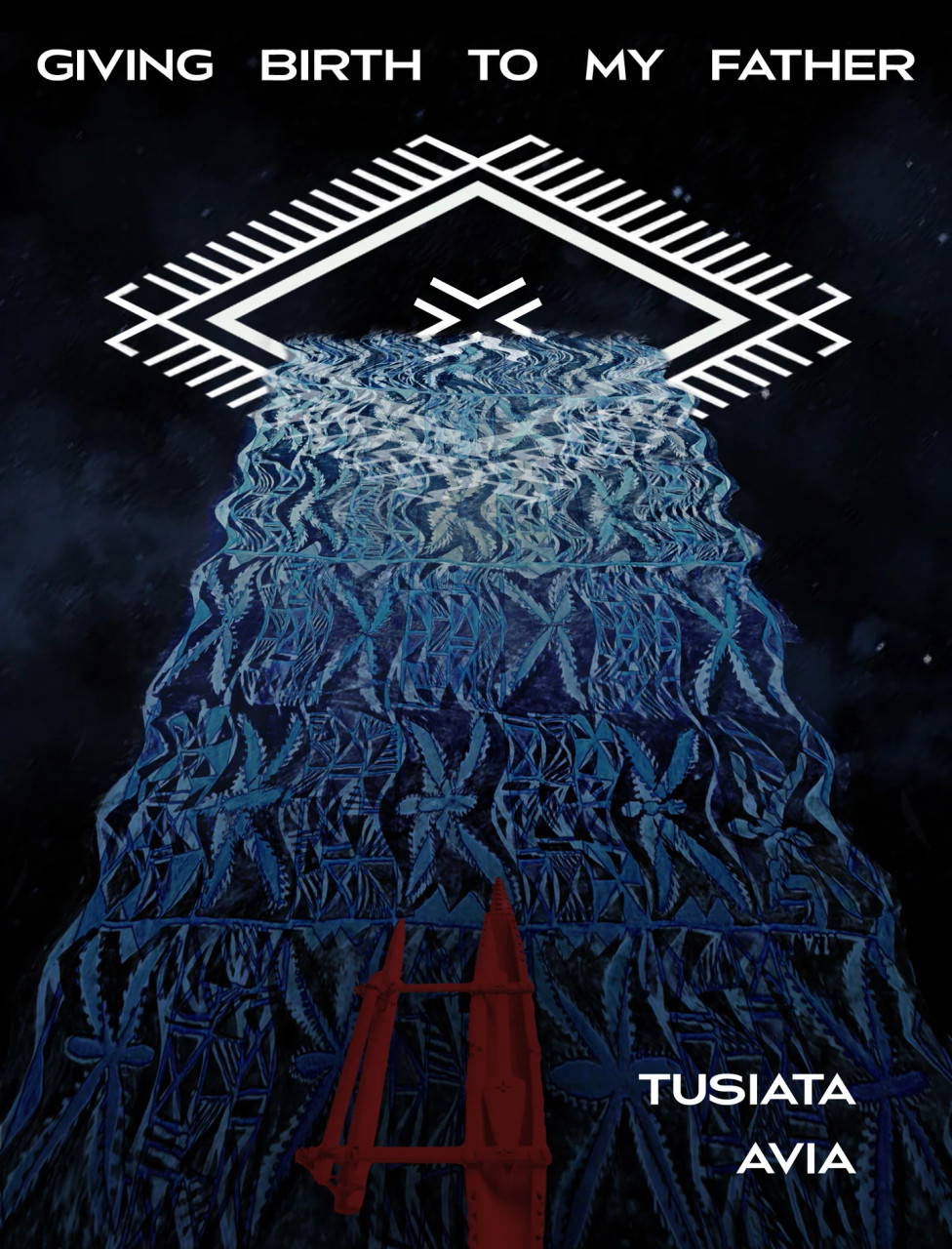
I set aside time to write this review on the 5th March 2026. There it is: a little blue block in my calendar ‘Review—Giving Birth to My Father.’ I can best describe this latest collection by Tusiata Avia as a piercing exploration of the death of her father, and the complex continuations of grief. I have much to say about it but, as always, sought the rush of a looming deadline to get the actual words down. The 5th of March arrived, a clear blue day with a cooling breeze, but before I sat down to write, the call came.
It was one I had been expecting. For several weeks a dear friend of mine kindly started every call, even when in tears, with reassurances. ‘He’s still here …’ Not this time. Her father was gone now, another kind person lost to a long illness. Passed away. Suffering no more. At peace. Whichever way it is said, it’s death. Sometimes, even for a poet, the poetic resonances of real life can feel a little heavy-handed. Or, perhaps, especially for a poet. Maybe an important part of being a poet is paying attention to, writing through, and writing out of, the intense parallels and too-perfect metaphors the world delivers to us. Avia’s new work certainly does this, and I can try my best.
It would be wrong to say that Giving Birth to My Father is centered around death. Death is a single moment, whereas the memory, loss, and grief permeating this collection are ever-enduring, ever-evolving creatures. They are like a wheke with curious tentacles searching deep recesses. No grief is simple, yet we often speak of ‘moving on’ or ‘getting over.’ Avia seems to suggest there is no such thing, only cycles and evolutions of Afterwards; a world made bleak, in which sense and beauty slowly begin to visit. Tusitata Avia’s father’s name was Namu-lau‘ulu Mikaio Avia, and he lived his life between June 1929 and October 2016. Memories of her world with him, and her world after him, intermingle in this collection like the movements of ‘Welcome Swallows / and Pacific Swallows.’ These birds, however, do not arrive until the final poem, so I’ll return to the beginning for now, and then all the words in between.
The first two of the book’s six (largely chronological) sections are titled: ‘This is how it was supposed to go’ and ‘This is how it went.’ These exist in tension with each other, introducing a gulf between the expectation, and actual experience, of Namu-lau‘ulu’s death. The first section only contains three poems, each written from Namu-lau‘ulu’s perspective. In the first, he speaks directly to Avia: ‘You sit behind your family … You are sheltered by their alofa.’ He describes his ideal ceremony: everyone is connected to ‘knowledge that runs deep as the ocean’; the orator celebrates his life, whisking the fue; fine drinking coconuts, taro, fish are served; the gift exchange is reciprocal and respectful; there is peace. Namu-lau‘ulu is able to rest: ‘I close my eyes, let the orator’s poetry shine across my face.’
The first person pronoun is absent from the second poem, and he speaks again to Avia, as she is attending to his body with time, care, ritual, and dignity. The third poem crashes in to inform us ‘But it didn’t happen like that,’ and Namu-lau‘ulu’ describes how ‘the cannibals gather, open their mouths wide / and they tear into me.’ This opens the door for the next section, ‘This is how it went,’ which viscerally depicts a stark, complicated loss. These poems are filled with family conflict, power plays, thievery, an empty body, anger, loss inside loss. There seems little hint of the ocean-deep knowledge, respectful ritual, and alofa pictured by Namu-lau‘ulu. After hearing his voice, it is confronting when he suddenly becomes something only acted upon—not always favourably. This demonstrates incredible skill on Avia’s part, who has successfully replicated (to, of course, a diminished magnitude) the dissonant whiplash of losing a loved one.
There is another push and pull at the heart of this collection, too, which is between the specificity of Avia’s experience, and the universality of grief. No one is ever alone in experiencing grief, yet all loss feels profoundly lonely. The exact conditions and details of a death matter to an intense degree, and also not at all. It is a paradox, it is a contradiction, and it remains so. Avia manages to hold this balance. Not everyone’s loved one became a body in a Sāmoan hospital; they did not all love to fish salmon in the Waimakariri; they were not all dressed in a Christchurch Garrison Band jacket for service. Yet anyone who has lost someone will feel their chest clench at the attention Avia pays to illustrating her father’s life, at how the deft use of each small detail is an act of remembrance. However, sometimes, illness follows illness, grief begets grief, and Avia manages to attentively explore this simultaneously. She draws together the threads of grief, her brother’s brain injury, and her own epilepsy—despair threatens to swallow everything more than once, but in the end cannot.
The careful shape of this collection becomes clearer once the whole thing can be appreciated. I recommend reading it as a whole, or a few sessions, and then returning to individual poems as they call. If this book is a journey, it is one that ends, and then begins anew again. There is an increased feeling of hope and movement as it progresses, as can be seen in a series of poems about three sequential anniversaries of Namu-lau‘ulu’s death. In ‘First anniversary: We go to dad’s house,’ the pain is still raw, and Avia addresses her father: ‘I’m unsure whether it’s you who is dead, maybe it’s me. / No, it’s definitely you.’
By ‘Second anniversary: I have my hand tattooed,’ the pain is embodied. As Avia is being tattooed—surrounded by women who are her upega—she sees the tupu‘aga (ancestors), one of whom carries a bowl of oil. Avia doesn’t doubt anymore, doesn’t even ‘need to ask … what this means because even I know, / this is meant for healing.’ Finally, ‘Third anniversary’ finds Avia and her mother visiting the Waimakariri, as ‘Welcome Swallows / and Pacific Swallows’ swoop overhead. She reflects, ‘perhaps they passed the boats of my father’s migration.’ This is not simply a lovely image for Giving Birth to My Father to end on; it is also a kind one. Having summoned monsters from the depths of grief any mourner would recognise, Avia’s closing words offer some assurance that the world continues despite them. If this collection were whispering a message in readers’ ears, it would be: the most powerful things we have at our disposal, in our suffering, are time, thought, connection, and art.
I find this an affirming and much-needed message. For this world we live in, so full of losses, and for our own personal ones. The recent news of my friend’s father brought to me that familiar, great rush of powerless sorrow—how can I possibly help ease the immensity of this? In writing this review, I have been reminded. There is no easing, no hurrying along something so important. There is only paying attention to all the details, precious or not. There is only feeling, remembering in mind and body, and letting rivers flow and swallows swoop. I forgive life for its overly poetic coincidences. My friend’s father’s name was Tom. Tusiata Avia’s father’s name was Namu-lau‘ulu Miakaio Avia. We will keep saying them.
Hebe Kearney is a poet from Ōtautahi who now calls Tāmaki Makaurau home. They are the founder of Blackout Poetry Aotearoa, through which they promote found poetry. Their work has appeared in places like: bad apple, Circular, Mantissa Poetry Review, Mayhem, Mote, Poetry Aotearoa Yearbook, Starling, Sweet Mammalian, Symposia, takahē, Tarot, The Spinoff, and Turbine | Kapohau.