Banjara
Banjara by Shana Chandra. Hachette Aotearoa New Zealand (2026). RRP: $37.99. PB, 336pp. ISBN: 9781869718411. Reviewed by Neema Singh.
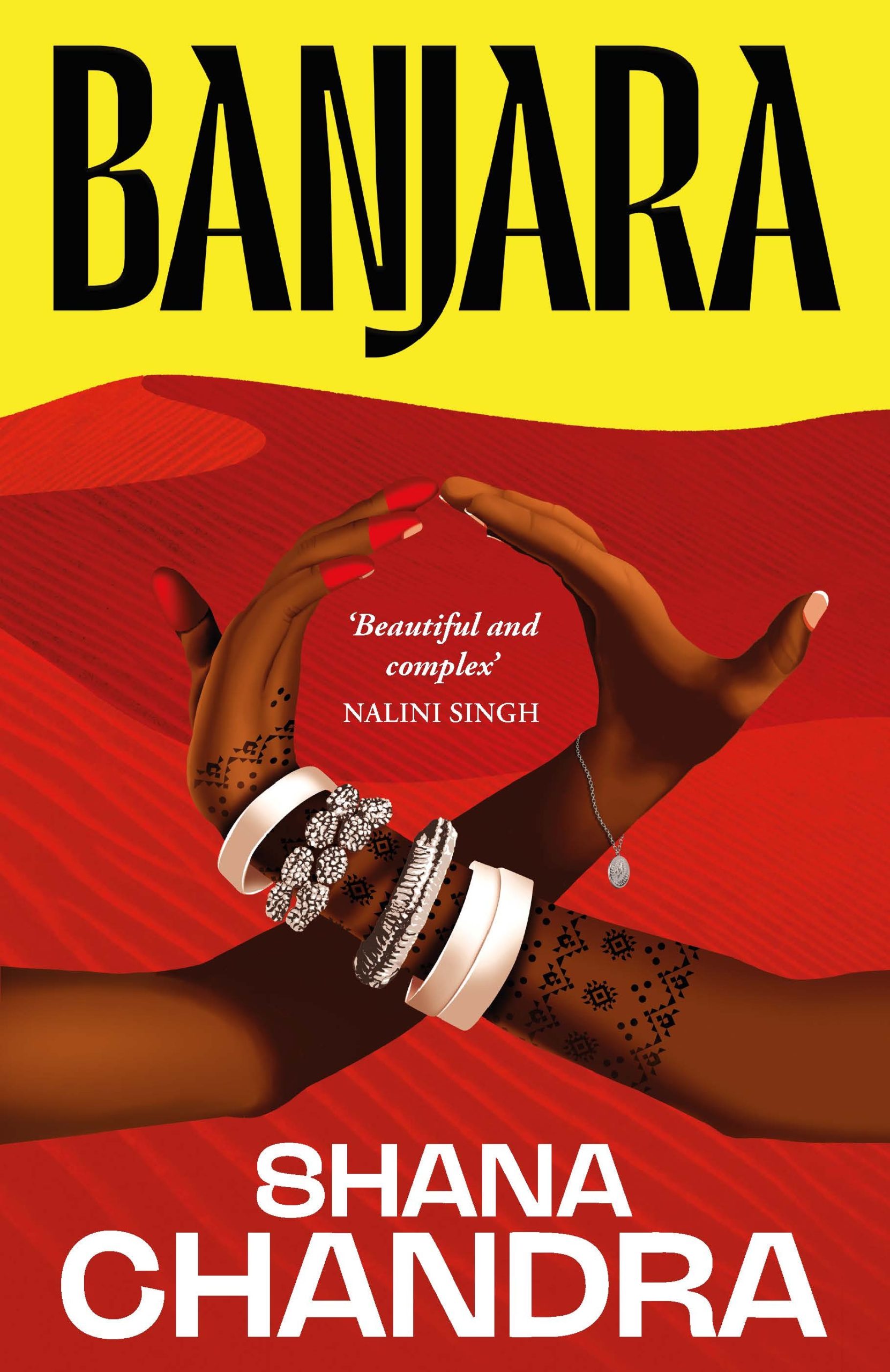
Banjara, the debut novel by Shana Chandra, brings to the forefront the very real history of the Girmitiya, the Indian people who were brought over to Fiji to work the sugarcane fields as indentured labourers under colonial British rule. This was a system that was in force between 1879 and 1916 with over 60,000 people emigrating from India to Fiji. While this specific historical occurrence unfolds in vivid detail within the book, the wider scope of this cultural legacy and its impact on the descendants of girmitiya today is explored through the lens of decolonial restoration and questions around cultural traditions, authenticity and identity.
The novel presents two narratives spanning 120 years, alternating between Avani and her great-granddaughter Meera. Avani’s story is set in 1888 and begins in Rajasthan, India, where she lives as part of the Banjara nomadic people of Rajasthan. As Avani tells her story we are taken on a journey from the warmth of her familiar home and family to the unfamiliar port camp in Kolkata, South India, then on board the ship the Hereford sailing to Fiji through to her arrival in Fiji. Her story is compelling, horrific and incredibly empowering. Through Avani’s voice we see the imaginative power of telling stories to fill in the gaps of lost history. Simultaneously we see Meera desperately seeking those pieces of lost history and lost culture through relationships, family and dance. Her story begins in Auckland in 2013 and moves through Melbourne and Rajasthan, India, as she searches for a clearer sense of cultural identity and belonging. The dual narrative is effective in highlighting the personal impact of the girmitya history on a people and their culture. It also reveals the tension at play in writing about a subject that is so significant yet relatively unknown. Parts of the contemporary narrative offer history lessons and analyses of the social and cultural impacts of colonialism, enforced slavery and a displaced and pieced-together identity—at times this is heavy-handed and feels like it belongs more in an essay or non-fiction text rather than a novel, but this speaks more to the enormity of the sense of responsibility on Chandra’s part in tackling such a complex and significant topic. The fact that this topic and history have had so little acknowledgement, within the Indo-Fijian community directly descended from this history as well as within the wider knowledge base and society of Aotearoa New Zealand and the Pacific, means that a book like this exists as a means of education and acknowledgement of the deep pain caused by the colonial British in carrying out an inhumane indentured labour system. It is a recognition of the unspoken mamae that has been passed on through generations, a recognition of the shame over this history and also a recognition that this intergenerational trauma still continues today.
Fiction as a means of gap-filling is a central role of this novel. Meera keeps coming back to questions about her ancestors and where they came from in India: ‘I wanted to know who we were before Fiji, before indenture had withered our backs and the coups had slapped us with shame. I needed to understand the land that my people had been born to, to know who they were before Fiji moulded us.’ The answer is unclear: ‘The problem was that the facts and stories we knew were too few, and some of the facts we did have could’ve been changed, just as our names had been.’ Chandra has meticulously researched the historical components of her novel including official immigration documents as well as a range of different sources that she lists at the end of the book but much of the knowledge is missing or problematic. There are so many unanswered questions that Meera has about her own ancestors, representing the unanswered questions of the descendants of girmitiya. Through Avani’s story, Chandra is able to fill in these gaps of knowledge by imagining the journey Meera’s ancestor undertook. Fiction here takes on deeper significance: through Chandra’s richly detailed account of Avani’s journey we are afforded a glimpse into the life of the people who travelled to Fiji from India, leaving behind forever their land and their people. Chandra’s writing sustains the account of Avani and her life in a realistic way with the level of intricate detail she offers. We see Avani’s village for example: ‘The fresh morning air is still cold with the moon’s milk. The tang from our night fire in the courtyard is strong, smoke whispering from the sweet dung and wood oil.’ Through Chandra’s narrative, Avani and her experiences are brought to life in a way that history cannot match.
Chandra’s novel also serves as a reminder of why interrogating our own history and place within the Pacific is so important. Knowledge of human slavery in our part of the world is lacking. At one point Meera recalls visiting the Chelsea sugar factory on a school trip as a child. This iconic Auckland factory represents every child’s dream school trip. But it also represents human slavery and its own history and role in this is unambiguous. When it comes to Aotearoa and the Pacific there seems to be a shame as well as a deliberate turning of the head. We are not interested: it’s boring, it’s embarrassing. On some level we don’t think our own history merits attention. This unconscious inferiority complex around the history of the Pacific means that we accept something like Chelsea sugar as a beloved Kiwi brand without questioning the ethics and the hurt that sits behind it. I applaud Chandra for bringing these issues to focus through her novel. As confronting as this history is, the people who suffered under the indentured labour system deserve the respect of knowledge and awareness.
Women are at the centre of Avani’s story of survival. From the moment we meet Avani, she is surrounded by her nani and her sister. When she leaves her family, she is in a camp in Kolkata, waiting to take the ship to Fiji. She lives with other women also waiting for the ship who are from different parts of India, with different clothing, customs and languages. Avani makes friends with Gita, she massages Madhu’s swollen feet and laughs along with Gayatri and the other women. When on board the Hereford bound for Fiji, women surround Avani: Ambha, Anu, Munali, Vidya, Daksha and others. At times there are so many names it is hard to keep track of each character. We are immersed in the lives of these women, embedded within their illnesses, within their illicit trysts, within the lives they have left behind, within their losses. The women take care of each other during the most difficult times imaginable. At one point on board the ship, the women ask for some dough from the cook to celebrate Ram Navami and are able to make only five gulgula to share out amongst them, ‘the only offering we can make with what we have.’ The image of these women together making and sharing sweets in such deprived circumstances is a striking one. The grim realities of living on board a ship for three months in the late 1800s, complete with cholera, smallpox and other diseases make for confronting reading. Vivid descriptions of the horrors aboard the ship are clearly depicted. As fiction this is beyond simple entertainment and imagination, it is an attempt at reckoning with the horrors that your own ancestors faced, at their hardship and at their incredible resilience. Reading this you cannot help but wonder, how would I have faced this? Somehow through all of this however there is a persistent sense of hope in the face of hopelessness. This is a story of resilience and survival, and Avani’s sense of hope within the sisterhood of women endures.
Dance is one of the key links that connects the two narratives of Avani and Meera. Meera’s story sees her searching for a clearer understanding of her identity and culture based on where her ancestors came from and while in Melbourne she comes across Odissi dance, the oldest classical dance form in India. This then takes her to Rajasthan in India where she joins a dance school. As we watch Avani also learn to dance Odissi in secret each day with Ambha, first on board the ship and then on the beach in Fiji, we also watch Meera learn Odissi dance. Both women reclaim their shakti or power within themselves through dance. Meera has some concerns about what Odissi means to her, especially when she learns about the history of the dance form and how colonisation almost destroyed it: ‘which dance was more genuine? The “purer” dance form embedded in Mahari ritual before British rule had neutered it, or the one we danced now, whose movements spoke of its repression and renewal and the survival of its artists? Which dal was more authentic? The one I ate here in the land of its origin … or the one I ate at home that had travelled to Fiji, and contained ingredients from Aotearoa, filled with a mother’s love?’ These questions around authenticity of cultural practice speak specifically to the girmitiya experience where so much of culture and history was simply lost. These questions also speak to the broader immigrant experience, especially further along generations where authenticity cannot be recovered but in its place there is a reclamation of culture and history in a new form. Meera’s dancing and her quest for belonging is ultimately something she must piece together herself, just as Avani pieces together her life anew after leaving her home.
While this is a novel that addresses a difficult, emotional and confronting history, this is also a novel of celebration. The two women central to the book, Avani and Meera, are strong, resilient and full of hope and love for their fellow human beings. The belonging that Meera seeks is answered by the words of Avani’s nani: ‘We nomads belong nowhere, and so we belong everywhere. Our home is in each footstep.’ Shana Chandra’s novel encompasses a huge scope of history, culture and colonial legacy but at its core, it is a beautiful tribute to the survival spirit of the girmitiya.
Neema Singh is a poet and features editor at Flash Frontier. Her work has appeared in Te Moana o Reo | Ocean of Languages, Ōtautahi is Flash!, paint me NZPS anthology, white-hot heart NZPS anthology, A Clear Dawn: New Asian Voices from Aotearoa New Zealand, Ko Aotearoa Tātou | We Are New Zealand, and NZ Poetry Shelf. She holds a Master of Creative Writing from the University of Auckland.