show you’re working out
show you’re working out by liz breslin. Dead Bird Books (2025). RRP: $35. PB, 82pp. ISBN: 9780473751500. Reviewed by Sylvan Spring.
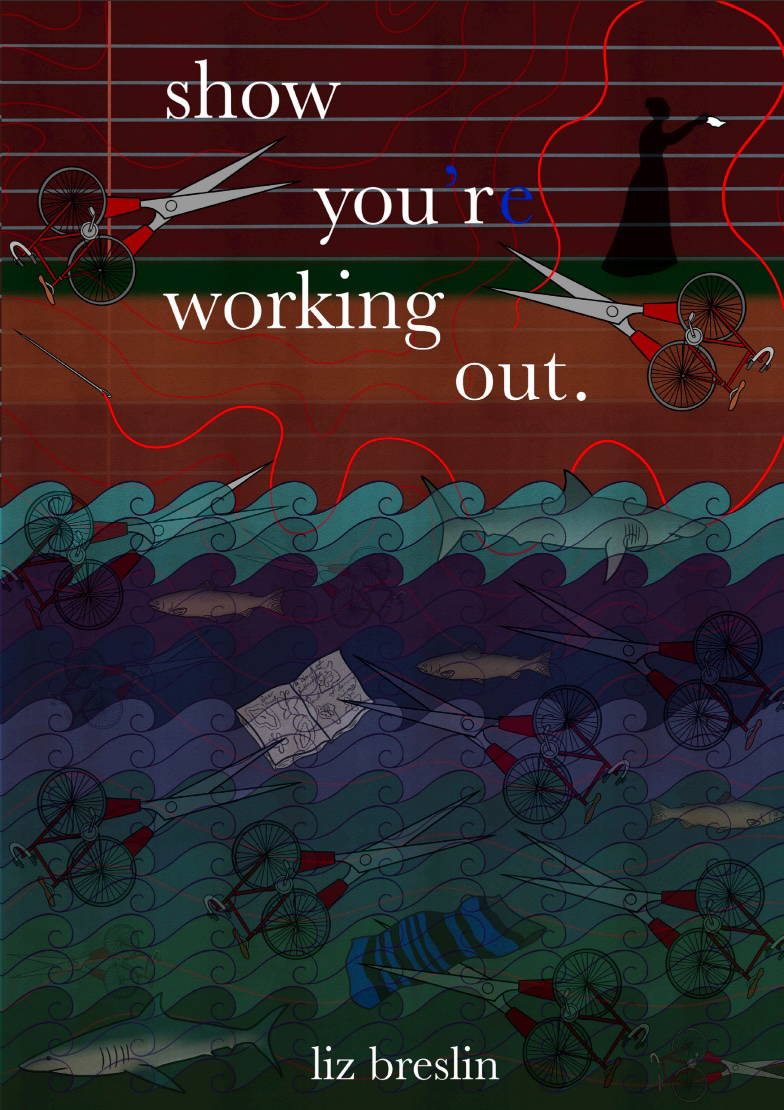
‘we were born to deviations / gentle ferocious / unexpected ways.’ This first line of the last poem in liz breslin’s show you’re working out feels central to the story they carry us through with this book. We’re all little freaks in our own gorgeous ways, and we can spend lifetimes desperately holding the lid on our deviations, or undergo the pain of gradually letting them out. liz, obviously, takes the second route, but reminds us that this isn’t often a choice. These ways that we differ from the social rules we’ve been so forcefully taught to abide by often burst forth into our lives and leave us no choice but to follow where they take us.
When I say deviations I mean the ones that this book is most preoccupied with, like queerness, gender variance, neurodiversity, niche special interests, being sensitive and caring deeply about the world. Deviations from a rigid, colonially imposed social structure that likes us neat and uncomplicated. In contrast, these poems are wonderfully messy and layered. The title and insertions of lined workbook pages for the section titles feel apt, because, like much of liz’s work, this is a great, heaving collage of things cut out and glued and stitched and torn and lovingly put together. I guess most books of poems are, but this one is so deliciously explicit about it, so willing to show its working out. I love how we come back to scissors throughout the book, from the bicycle-handled scissors on the cover (perfectly drawn by Jess Hinerangi), to the way a pilates class and strange features of white women’s wellness culture are cut and spliced with the horror of the genocide in Gaza and the systems eroding all of us, to the way queer women literally tear up expectations of girlhood, to TikTok videos about scissoring and the infamous ‘knee move.’ Like many great poetry collections do, show you’re working out constantly circles back in on itself in a way that scratches my brain so delightfully I feel like a dog thumping its leg as it gets its belly rubbed.
show you’re working out starts with pain and repression, the ways we make ourselves small, and the things we tolerate when we haven’t been shown how to embrace our glorious deviations. It reckons with assault and intimate partner violence on personal and institutional levels. In one poem, we see the infamous black and blue/white and gold dress of 2015 viral internet fame showing the distortions through which many men view the same violence that women and gender minorities can see for what it is: men exploiting the system of patriarchy to do whatever they like to their significant others, visiting the pain of their floundering, unborn emotions onto those closest to them. Previously, I’d only thought of Dave Dobbyn’s ‘Loyal’ as a limp sort of patriotic anthem, but in ‘Why didn’t I just,’ liz casts it in a new light—a man forcibly holding on to an estranged relationship, with new menace echoing in ‘keep it that way.’ This section of the book is interested in the kinds of lives the world demands from people socialised as women and how our unruly selves keep breaking through regardless. ‘crying games’ shows us the roles those socialised as women are expected to play for the men in their lives: ‘where has my happy girl gone / he says / he’s come home and wants / to play families,’ as well as the shit they’re expected to endure: ‘you look like a toad when you cry / he says.’ Queerness pokes its head in, too, with liz flinching the first time a girl kisses them.
In an emotional centre of this sequence, ‘the pattern’ is a dense wall of anxious ‘if’s that tries to reach an impossible form of perfection in order to put a stop to abuse. On a quieter level, this piece feels like a desperate attempt to keep the poet from who they really are and what they actually want, because in this is the terrifying act of change and leaving behind the familiar. But leave it behind they do, with this suite of poems ending with liz reaching gently through a cloud of dancing vulvas, and determining that the ‘only way out is in’.
I am not a believer in the ‘narrator’ sandwiching themself between the poet and their poems. Unless otherwise stated, to me a poem is the closest words will get to a mainline to the poet’s soul. I feel this deeply in the later poems in show you’re working out, like “instructions not included”, which speak to being queer and having to make your own way, without the rules and scripts hetero life is often lived by. liz is particularly interested in queer domesticity and the sweet, small and quiet things love can become over time: ‘there is a kind of love called maintenance / and i am looking up humane rodent / traps while watching not watching escaping twin flames.’ In one of my favourite poems in the book, ‘making makowiec’ (a kind of Polish poppy seed cake), we see liz trying to make the cake in the midst of a gorgeously messy life where the ceiling leaks, the phone screen is smudged with batter, the tap stays on all night dripping failure, and the rain gets through their waterproof clothes. I see myself in this chaotic domesticity where you’re trying to make something lovely and ancestral but all these disorderly elements keep breaking in, and eventually you have to accept it all as part of your sweet and ridiculous life. And I like how this sets off all the poems that are filled with rigid ideas of what is acceptable for women to do, like the 1800s guides to cycling and knitting in the previous section.
‘nature poem’ works on a similar level, where liz is having to deal with a maggot-filled rug courtesy of their cat. They get bleach on their black jeans and eventually can’t tell a maggot from a grain of rice or a piece of lint. By the end, the cat returns to liz, who is lying with the cleaned rug rolled up on the grass, and the cat weaves through the rug to bring the maggoty mouse torso back again. I love this begrudging embracing of all the mess! And I love that it’s called ‘nature poem,’ because maggoty mice are nature too, the kind that we like to shut out and relegate to the tip. I just finished Lauren Groff’s The Vaster Wilds, an incredible book about a young girl fleeing across pre-colonial Turtle Island. It heavily reckons with how nature’s beauty is so tied up in the abject and the violent, and ‘nature poem’ feels like a small, homely nod to the same. On the other side of conceptions of nature, I relate deeply to ‘the reel tradwifes of Dunedin.’ The poem is suffused with the feeling that you need to be this perfect, earthly mother to your own inner child, pickling and bottling and foraging and meditating with the trees like the TikTok tradlife fetishists tell us we should, and how quickly this can become smarmy, annoying and quite unnatural.
This collection is so peopled, so full of community, and so deeply in dialogue with a range of different texts and authors, from 1800s worktable guides to scissoring TikToks, from Miley Cyrus to Shaz from the Speights ads to Hone Tuwhare. This makes sense, knowing the collaborative spirit that fills liz’s creative practice. I’m thinking of rail:lines, the cycling poetry tour across Otago and subsequent film they created with Laura Williamson and Annabel Wilson. I’m also thinking of the Possibilities Project, where they wrote a poem inspired by Polish poet Wisława Szymborska’s ‘Possibilities’ and then invited a number of other poets to create their own poetic responses. Again, though, my favourite moments of community and queer joy in this collection are the quiet ones: taking seventeen tries to back in a trailer with the support of a friend/lover, or trying to make two mannequins (which liz and their friend have decided are lesbians) hold hands on a Kathmandu shop floor, and that same friend later holding their bandaged hand above water as they swim.
The middle section of the book turns its attention towards the systemic, particularly looking at colonisation and the institutions and beliefs built out of it. These poems grapple with not only the impact colonisation continues to have on Māori, but how it continues to hurt Pākehā settlers by wedding us to restrictive sets of rules and divorcing us from land and truth. I particularly enjoyed ‘Colonise your own adventure,’ a necessarily nonsensical choose-your-own-adventure journey taking us from Norfolk to Aotearoa on a ship called the Taranaki. The poem splits us between two versions of one person: Hannah Eleonora Hayes, wife of Ernest Hayes, a man who travelled to Aotearoa from England and was known as the founder of Hayes Engineering in Otago, which turned out inventions like small wind turbines to assist local farmers. I describe Hannah’s life only by the exploits of her husband’s because the nuances of hers have been all but scrubbed from the historical record, a trend noted in the poem. The other version of Hannah spliced into the text is a version I assume is closer to liz in character. This version meets an enchanting woman called Miss Fox onboard the Taranaki, a woman who shares fish with Hannah and tells her that comets are the flowers of the sky, a burst of poetry in an otherwise bleak, churning voyage. The historical version of Hannah must follow all the arbitrary rules for women of the era—it’s a choose-your-own-adventure but she doesn’t get any real choices because she’s a woman in the 1800s borne down by patriarchy. But the poem doesn’t let us forget that she’s still complicit in this system that benefits her by oppressing indigenous people. The version that is more like liz gets to live with Miss Fox, growing marigolds and violets and figs in a world outside the world, like the precious few who had the means to live into their queerness as an escape from the tight buttons of the Victorian era.
I want to finish on two beautiful love poems that sit on adjoining pages. ‘hot shower time machine’ is a tender celebration of where all the pain and journeying we see throughout the book has gotten liz to, that they’ve wound up with someone they truly love, getting to warm themself in a shower under the stars. ‘i don’t understand what a biome is but ours’ is more gorgeous queer domesticity: ‘i am learning / you weave me paper / i grow you cornflowers / people / say we are adorable / you have seen / me cry and love me / anyway / if this / is a biome i like it i mean / love.’ This is where the pun of the title really gets to work for me—playing with the your/you’re in show you’re working out—because we can see in this book that even with the casting off of age-old expectations, there still comes a pressure to prove you’ve made yourself a good life. Especially when you’ve left a lot behind, maybe you feel frustrated or guilty for having spent so much time trying to be someone else, or maybe you feel you have to justify the choices you’ve made. In the intimacy swimming in the margins of liz’s life and the playful experimentation we’re let in on in these poems, we see the deep imperfection of a good life. It is filled with beauty and love and friendship and also leaky ceilings and maggots on the rug and wounded hands that need to be held above water.
Sylvan Spring is a Pākehā writer who lives in Te Whanganui-a-Tara. Their first poetry collection, Killer Rack, was released by THWUP in 2024.