No Good
No Good by Sophie van Waardenberg. AUP (2025). RRP: $24.99. PB, 80pp. ISBN: 9781776711789. Reviewed by Hebe Kearney.
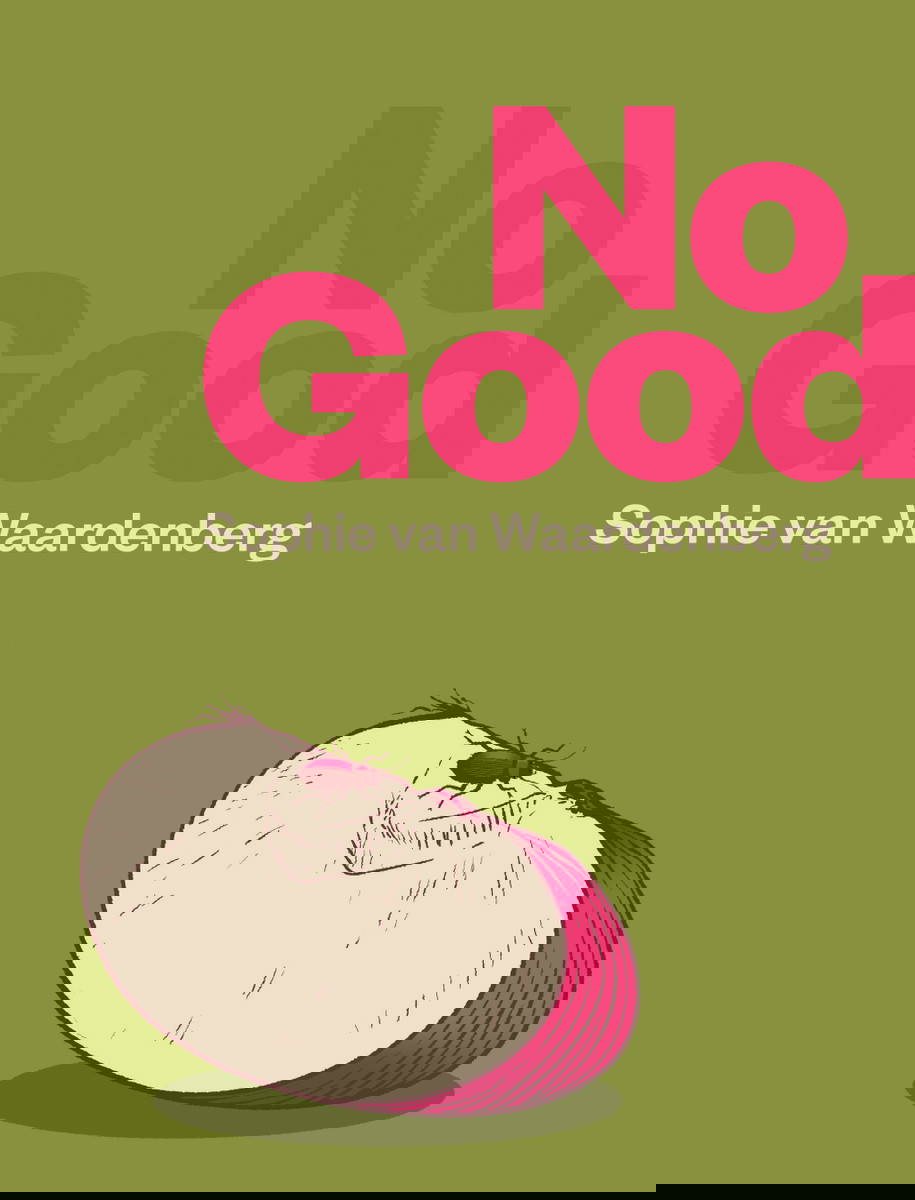
No Good is a striking, clear, and soft collection of poetry. It holds the tension of these disparate adjectives perfectly, and while it is at times a sorrowful work, it is never a disheartening one. Upon reading it, I felt like a window had been thrown open inside me, a once stuffy room now full of fresh air. And much like a breeze, it is not exactly important to know where it blows from, or what pollen it carries on its breath. Suffice to say, the collection, for all its grounded, detailed, explorations also contains that hint of unknowability key to any good poetry. Yet there are some aspects of the collection that my mind keeps returning too, touching the shape of, contemplating.
Something I have long admired about van Waardenberg’s work is her diction; she excels at making even the simplest words create a precise, complex picture. As a poet, it can be all too tempting to reach for an obscure word or ‘poetic register’ for the sake of it, but van Waardenberg has extraordinary command. In ‘FREE TRAMPOLINE,’ she writes: ‘If I could, I’d praise the world— / how this, how that, how the darling other—.’ There is no need for stifling words, heavy vocabulary. The simple brilliance of that feeling and moment are captured perfectly by the repetition and variance of familiar words. ‘I went home, I came back away, / I don’t know what else I can tell you’ she reflects at the beginning of ‘Germination’, and these few lines do so much emotional work. The use of ‘went’ and ‘came’ situate the speaker’s sense of themselves as ‘away’ rather than ‘home.’ George Orwell’s ‘six rules’ of writing (from his essay Politics and the English Language, 1946) comes to mind. Specifically, rules #2 and #5: ‘Never use a long word where a short one will do’ and ‘Never use … jargon if you can think of an everyday English equivalent’. Van Waardenberg does completely wonderful things with a similar premise.
Yet her writing is never without depth or nuance. There are always underlying currents of feeling that her words sketch the landscape of. Nowhere is this more apparent than in a series of poems at the literal heart of the collection, all titled ‘Cremation Sonnet.’ Exploring the loss of her father at a young age, van Waardenberg uses specific details—‘What’s in their needle, how blue’s the vein / Where did they close you?’—and detailed imagings—‘Then the sea /took your dust on its smooth tongue and moved on’—to create an almost otherworldly sequence of poems that capture the turbulent essence of grief. The details of the loss ground these poems, and they depict grief for what it is: ever-regenerating and never actually over; always shifting. The first ‘Cremation Sonnet’ uses repetition of ‘you come back’ to illustrate the ways those we have lost visit us: ‘with clean long hair;’ ‘normal but you’re swelling;’ ‘wading nowhere.’ She asks, ‘what song is it, when you come back, that you sing?’ showing how the dead may repeat themselves onto us, but they do not allow us anything more of them. In some sense, these repetitions are nightmares or hauntings, and in another they are comfort—either way, they are ongoing. This sense of grief as something one lives with, rather than grows out of, is bookended by the final cremation sonnet which ends: ‘Satisfaction as in leaving / Leaving this behind, though I can’t.’
Despite this deep exploration of grief, the tone of the collection is not sombre; partly due to the way it is peppered with glistening joys and humours. Though these, too, are without weight. ‘At Afternoon Tea She Asks: Why Did You Decide to Join Lesbianism’ is enough to make you laugh aloud, as van Waardenberg catalogues ‘becauses’ (‘Because when I make the first kiss;’ ‘Because I gave up on the gentler slope;’ ‘Because the girls;’ ‘Because because’) before leaving a strikingly melancholy impression of ‘the shape of my teeth / in [the scone’s] cold butter, its warm dough’. The pain of not being understood by family is somewhat soothed later, as queer love glimmers throughout the collection. A relationship blooms and fades in the final section. ‘we were fresh and fine /and unfamiliar … We were lucky and alone’ becomes complicated with too much knowing, and finally: ‘Love with you … / It was the best. / We have agreed it. / We have both said Was.’ Yet one is left with the impression of a dried bouquet, rather than rotten petals. van Waardenberg’s ‘love poems’ are fresh and gorgeous, and self-reflective without feeling confessional.
In this way, van Waardenberg writes a lot about letting go of the guilt of being human, feminine, queer, aching, and always wanting more. But very much not in a self-empowerment-girlboss type way. In a soft, complicated, hurts-but-hurts-well kind of way. Throughout the collection, van Waardenberg is tearing off a lot of bandaids, but never pretends that the process is painless. In ‘Sticky,’ van Waardenberg muses on a duality in girlhood. Considering how ‘a girl can have a piece of everything /as a treat’ and ‘shovels /strawberries into her mouth,’ their ‘sugar is enough to fill the hour.’ The stickiness evoked is not simply whimsy; as the poem progresses van Waardenberg examines the other side of it. ‘A girl is filth and bright.’ Though sweetness, sugar, and strawberries are beautiful, their lingering can imply uncleanliness—the sticky side of joy. She asks, ‘How can a girl get clean again?’ a question tying into what is, perhaps, the collection’s central theme: Goodness.
Throughout No Good, van Waardenberg indeed grapples with ‘goodness.’ What it entails, where to locate it, and how one comes to possess or lack it. This preoccupation is often refracted through the lenses of loss, grief, love, and possibility. She is often striving for an exact something that, for the pressure it exerts, must remain unnamed. The ‘I’ of this collection feels ‘almost ready for this life’—perhaps it is a life where one ceases to be concerned with things good or ungood, and simply ‘reaches’ for the next, beautiful and melancholy thing.
Hebe Kearney is a poet from Ōtautahi who now calls Tāmaki Makaurau home. They are the founder of Blackout Poetry Aotearoa, through which they promote found poetry. Their work has appeared in places like: bad apple, Circular, Mantissa Poetry Review, Mayhem, Mote, Poetry Aotearoa Yearbooks, Starling, Sweet Mammalian, Symposia, takahē, Tarot, The Spinoff, and Turbine.