Childish Palate
Childish Palate by Shariff Burke. Tender Press (2026). RRP: $32.00. PB, 242pp. ISBN: 9780473762490. Reviewed by Cybonn Ang.
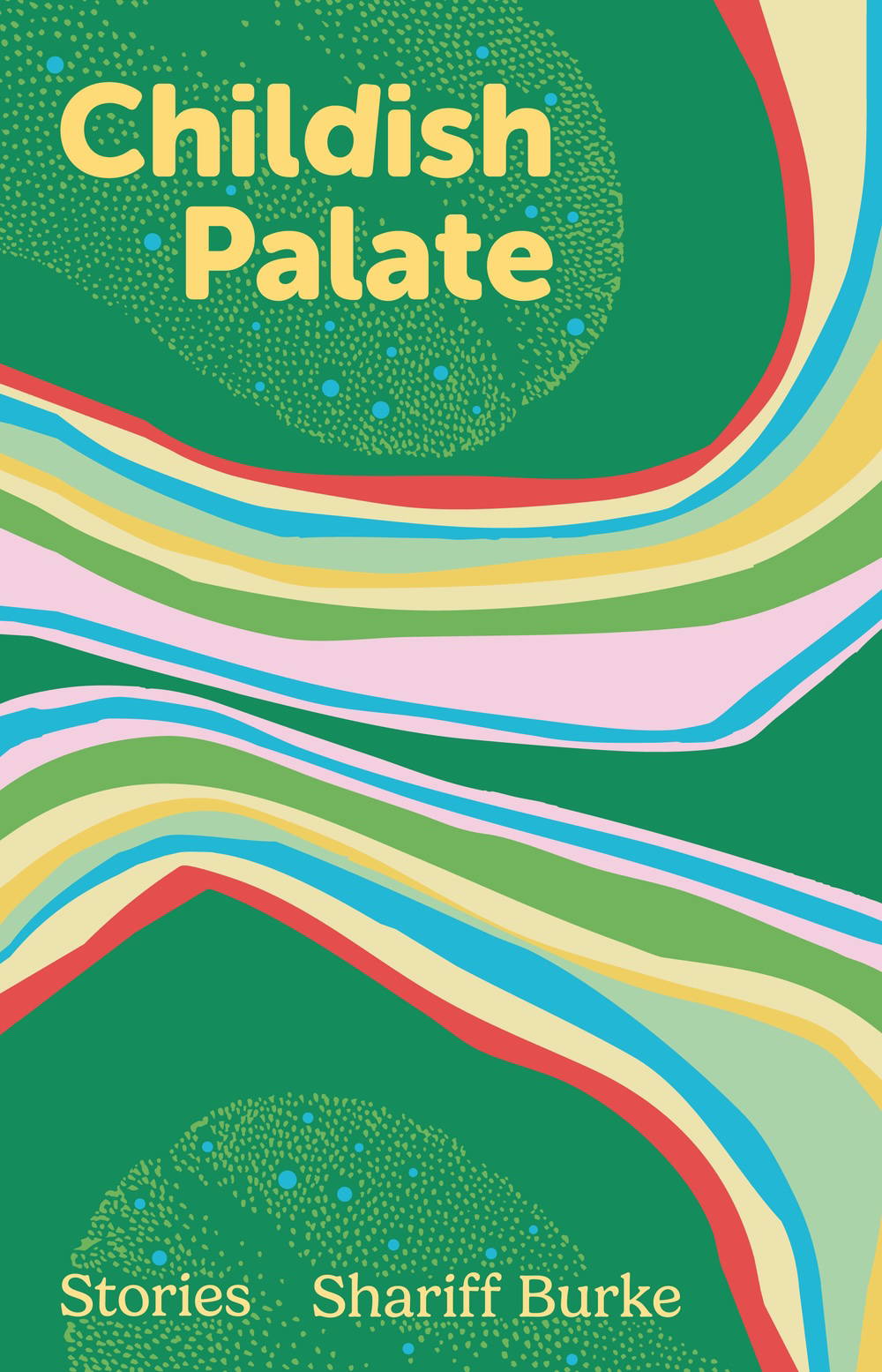
Childish Palate, Shariff Burke’s debut short story collection, brings together eleven stories centred on protagonists from a range of Asian ethnic backgrounds. Food is involved in all of them—the business of it, the enjoyment of it, the elimination of it. Just thinking about the myriad of things that food can evoke within the limits of the short story stoked my appetite for this collection. I approached it as eagerly as I would a new and promising Asian resto in my neighbourhood.
The collection falls into a clear division between realist and speculative stories. This flavour mix does not taint the offering, instead it highlights the sparkling gems that Burke can come up with when he goes down the post-modern, uncanny, absurdist road (where we might imagine Italo Calvino waits for him with great pleasure). When these pieces (‘Half a Life,’ ‘Miramar,’ ‘Pipes,’ ‘I Keep Receipts,’ ‘The Falling Sky,’ ‘Feast of Life’) are showcased alongside his realistic fiction (‘A Piece of Sweet Cake,’ ‘Childish Palate,’ ‘No Girls in KB,’ ‘A New World,’ ‘Wave after Wave’), the latter feel comparatively dim.
‘Half a Life’ is about a father who comes back to earth on the seventh day after his passing (a belief many Asian cultures share) to find that his daughter has taken over his takeaways shop and is making all manner of changes he strongly disapproves of. Alice obviously has a talent for running a food business which the now-dead Peter still is not ready to admit. ‘This is our fish ’n’ chip shop, not our cultural cuisine. Why does she see it as her fight?’ Peter complains. This stubbornness to acknowledge his daughter’s talents keeps him in some sort of limbo in the afterlife.
In ‘I Keep Receipts,’ Angel, a performer and online influencer, learns to her horror that her perfect flatmate, who likes the same things she does, is actually one of her superfans. The scary realisation slowly dawns as she watches Mel make an omelette in the exact way she had posted online. ‘Mel piled a teaspoon of Laoganma chilli crisp onto the cooked eggs, just like I did. She served it over dark rye bread, the same German one I used.’ Angel is appalled that Mel, who is ‘sufficiently versed in wokeness,’ might discover the inconsistencies between her real life and her carefully curated online persona. ‘I became stiff in her presence because I didn’t want to blow up the dewy myths she believed of me. How long before my fan would stop loving me?’ She mulls how best to help Mel from becoming disillusioned with life’s imperfections. All this pondering is wasted, however, in one careless incident.
The same commentary about smug people having to face the inconsistencies of their perfectly constructed world is dished out in the highly amusing story, ‘The Falling Sky,’ where a talking rat calls out a father for his hypocritical efforts to save the earth which he does partly to please his young daughter Maddy. When the rat appears in his house chanting, ‘Om Shanti, I am one of this earth, one with our environment,’ the truth of just how much Liam loves his fellow creatures comes out: ‘Hey stop that yoga gibberish shit, you filthy yoga-rat!’
Maddy (or a character with the same name) reappears in another story, ‘Feast of Life,’ where she offers melancholic reflections as a 64-year-old woman. Maddy is now writing from the dystopian future ‘… the old homes below the sea wall are long past recovery … All those things we loved, we’ve had to let go of.’ She remembers the last period of plenty that she and her dad enjoyed during the pandemic days of the 2020s, burgers eaten with knife and fork, a far cry from her present: ‘I’ll pick some kōkihi and whatever else I might find. We all have foragers’ eyes now.’
Scattered amongst these strikingly memorable, amusing and speculative stories, are the realist ones: these tend towards a typical Master Chef arc, a career in food as the goal. ‘Wave after Wave’ is the story of a Singaporean chef who studied in New Zealand, only to find that life unfolds far from his hopes. ‘No Girls in KB’ and ‘A New World’ both end like cooking show finales, their protagonists receiving the equivalent of a grand prize: the job of their dreams. ‘A New World’ itself starts out with an absurd premise—in order to escape his boring office job, a man called Thiru dons a special black jumper and heads down to the local New World where he helps out customers with their purchase decisions. The story could have gone down its own merry absurd way but is inexplicably kept in the territory of the mundane. ‘A Piece of Sweet Cake’ and ‘Childish Palate’ present food as a connection to one’s homeland and as an expression of love and nurturing—common themes in cooking shows.
While some readers will surely relish these narratives, they leave me with an unmet appetite. However well entrenched in our psyches and justifiably well-loved this type of story may be, it doesn’t quite tap the full power of the short story form—nor the rich possibilities of using food as a literary device. One thinks of ‘Soup’ by Fiona Kidman, or the very short, rather comical ‘Toasted Sandwich’ by Patricia Grace, both of which demonstrate just how incisive and evocative such storytelling can be.
Burke’s talent for creating lovable and sympathetic characters, however, means that while these pieces might deal with familiar struggles that immigrants experience in Aotearoa, he is able to elevate his characters’ desires beyond the merely cultural to the universal, a testament to his skill.
Burke also writes beautiful, mouthwatering descriptions of food. At times, though, these delectable passages give way to a puzzling turn of phrase, as in these examples from the title story, ‘Childish Palate’: ‘In a large, green serving bowl, he drizzles golden flaxseed oil over piles of mashed fava beans dotted with aleppo chilli powder. He scrapes grilled eggplant from the hot oven tray; it’s moist, charred, and pillowy … “My mother’s recipe,” Ramzi says. “I hope you die for it.”’ Later on: ‘The Cuckoo steams and soaks rice so gently that each grain emerges individualised, probably with its own sun, moon, and rising.’ Some surprises may not be for the faint of heart, as when an appetising suggestion suddenly swings to the stomach-churning category: ‘The rice has congealed into a ball that traps the garlic, ginseng and other herbs, like a sticky rice rat king.’ Please, whatever you do, do not google ‘rat king.’
There are other instances where Burke’s playfulness results not in a vibrant piece but in a confused muddling of flavours. Also in ‘Childish Palate’ Jun, furniture restorer and great cook, is falling in love with his much younger flatmate Jordan, an architectural student who eats nothing but pizza. Jun longs to awaken not just Jordan’s palate but his sexual appetite as well. Both characters are depicted with such pathos; however, the odd choices in diction and detail break the dream abruptly and jar the reader at the most crucial moments. In one scene where Jun decides to cook Samgyetang (ginseng chicken soup) for Jordan, we find him in the kitchen wearing his ‘expensive silk dressing gown.’ He is chopping green onions after having just washed the chicken, ‘its skin recently exfoliated with coarse salt under a running tap.’ The silk gown detail is sensual, but thoughts of salmonella ruin whatever effect it is meant to have. There is nothing in Jun’s otherwise thoughtful character that heralds that he would opt to wear an expensive robe while handling raw poultry.
And for all the happy endings in this collection, of which there are a few, there’s also quite a lot of sighing: 18 to be exact, from ‘Sigh.’ to ‘She sighed a little more.’ Even for a collection of stories about depressed and dreamy immigrants, this is probably too much.
At this point, it’s worth remembering that this is not an anthology assembled to showcase a range of writers, cultures, and cuisines. These stories come from a single author, writing across multiple ethnic perspectives. For some readers, that ambition may feel like overreach and too ambitious in the contemporary context where the norm is to defer to our own cultural, lived experience, and if authors choose to step beyond their own backgrounds, then sensitivity or diversity readers are brought in.
This is a book with a brave vision. The world loves brave things. The only rule is that: it must be well done. If this were a new Asian restaurant, I would tell you to give it a try as I personally love some of the offerings, although a few do not quite pique my palate. That is not to say that the chef is not brilliant, just that the dishes probably needed more time in the oven.
Cybonn Ang is a fiction writer and poet of Filipino heritage. Her most recent works can be found in adda, The Three Lamps, and A Clear Dawn: New Asian Voices in Aotearoa New Zealand (Auckland University Press). She has a Master of Creative Writing from the University of Auckland and currently writes from Montreal, Canada.